
A government anti-drug poster accidentally told people to take drugs: and it became the most effective public health campaign Hong Kong has seen in years.
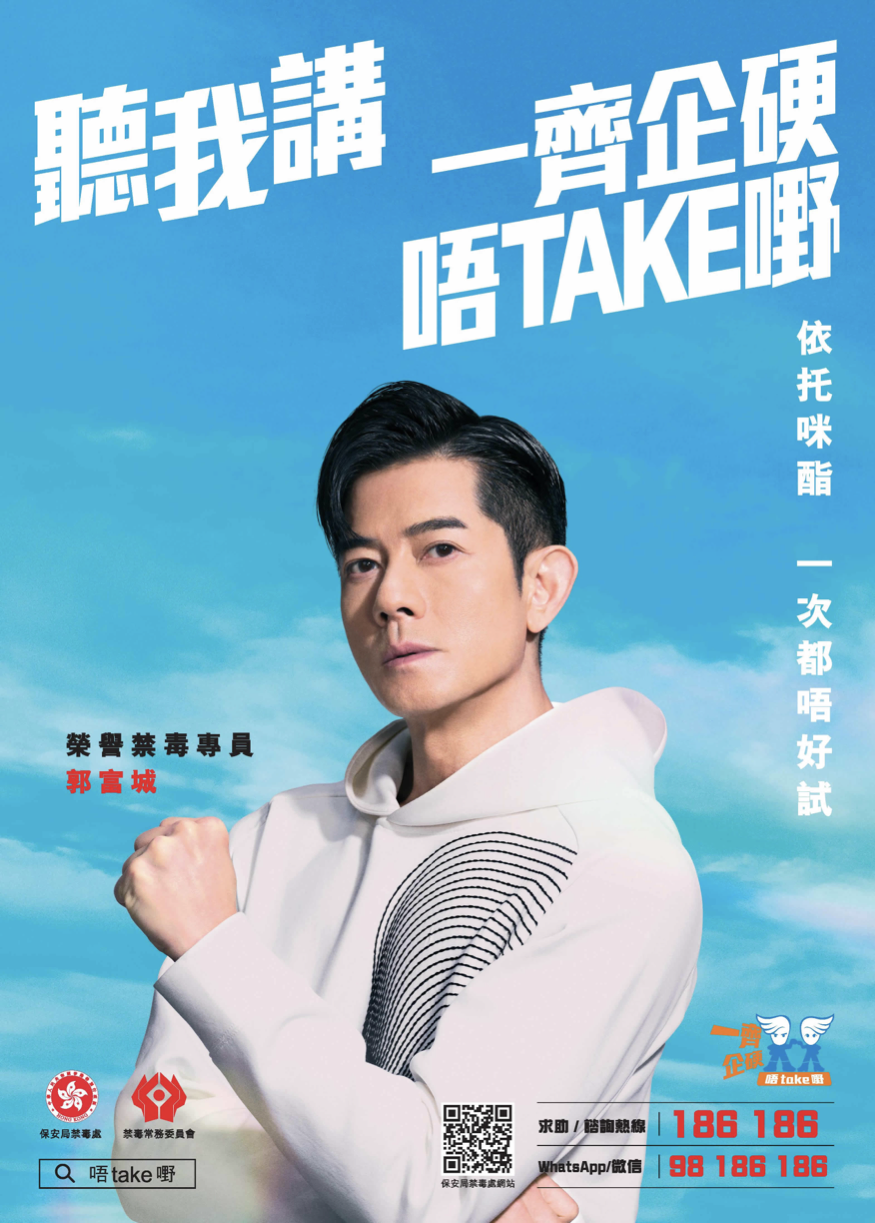
Let me explain: and show you why most campaigns miss the moment that made this one legendary.
The Incident
On 17 March 2026, Hong Kong’s Security Bureau launched an anti-drug campaign at Harbour City, appointing Cantopop legend Aaron Kwok (郭富城) as Honorary Anti-Drug Commissioner. The slogan: 「聽我講,一齊企硬唔take嘢」, “Listen to me, stand firm, don’t take drugs.”
Two days later, a poster went up at TST MTR station. A structural pillar physically split the word “唔” (meaning “not”) from the rest. Commuters read: “一齊企硬 Take嘢”: “Stand firm and TAKE drugs.”
Photos hit social media within hours.
We deployed AI-driven social intelligence to monitor this campaign in real-time using our proprietary analysis engine. Here’s what 28,445 mentions, 1.17 million engagements, and 25.9 million reach look like when you can actually see them happening.
The Top 10 Posts That Drove the Campaign
| # | Author | Platform | Engagements | Content Type | Link |
|---|---|---|---|---|---|
| 1 | MUSE TV (@musetv_hk) | 20,263 | “在香港,我們不說你好” — participatory reel teaching the hand gesture | https://www.instagram.com/reel/DWO2DORCdko/ | |
| 2 | 晴天林 (@sunnylammusic) | 16,909 | “2026最潮打招呼方式” — celebrity framing slogan as social behaviour | https://www.instagram.com/reel/DWd_FvPE9fF/ | |
| 3 | 樓聲機 (news IG) | 8,886 | 黎明 vs 郭富城 anti-drug ambassador comparison | https://www.instagram.com/reel/DWaEFd8DXVQ/ | |
| 4 | 晴天林 (@sunnylammusic) | 5,707 | Musical parody “國貨城2026禁毒精選大碟” | https://www.instagram.com/reel/DWT4fppkw9I/ | |
| 5 | AM730 (@am730hk) | 5,560 | Media adopting campaign language in marine cocaine story | https://www.instagram.com/p/DWbkPZ1icCa/ | |
| 6 | c.s_mann (@c.s_mann) | 5,192 | Fan reel of Aaron Kwok demonstrating the slogan | https://www.instagram.com/reel/DWRyM3Qk99a/ | |
| 7 | fungmadeit (@fungmadeit) | 4,312 | Street-level recreation: friends performing slogan together | https://www.instagram.com/reel/DWf9Ej3TQVF/ | |
| 8 | s.yuenlaam (@s.yuenlaam) | 1,651 | “2026新潮語” — performing the slogan as cultural phenomenon | https://www.instagram.com/reel/DWjFLYdgUpV/ | |
| 9 | 星島頭條 (@singtaoheadline) | 1,409 | 廿四味 Brian urging youth anti-drug — community leader | https://www.instagram.com/p/DWVx7afDis4/ | |
| 10 | Sarah & Jason (bilingual edu) | 1,002 | SAY NO TO DRUGS — EN-Cantonese educational post | https://www.facebook.com/861292347360446/posts/1480860440263751 |
Combined: these 10 verified campaign posts generated 70,891 engagements.
Metrics as of 31 March 2026.
Why These Posts: Not Others, Won
Three patterns emerge from the data that most campaign managers would miss without real-time intelligence:
1. Participatory Content Crushed Broadcast Content
The #1 post wasn’t a celebrity endorsement. It was MUSE TV’s reel teaching people the hand gesture, framed as “In Hong Kong, we don’t say hello. We say:” with Aaron Kwok and supporters demonstrating. That’s a participation invitation, not a message broadcast. It hit 20,000+ likes and 263 comments, outperforming every traditional media post in the dataset.
70% of campaign-specific engagements came from “slogan-engagement” content, posts that invited audiences to use the slogan, not just view it. Participatory content outperformed broadcast news content by 8:1.
What this demonstrates is a Permissionless Participation Architecture, the campaign supplies all the building blocks (slogan, gesture, soundtrack) so anyone can remix without waiting for official approval.
2. The Platform Dynamic Is Counter-Intuitive
Facebook dominated volume (14,137 mentions), but Instagram dominated impact. Just 587 Instagram posts generated 904,623 engagements, an average of 1,541 engagements per post. Facebook averaged 19 per post.
This isn’t a “be on Instagram” lesson. It’s a format lesson: the campaign’s visual and audio elements (slogan, gesture, dance) were inherently reel-native. Instagram’s format amplified them. A text-first campaign would show the inverse pattern.
3. The “Crisis Dividend” Was Real: But Brief
The poster misprint generated 6,888 engagements across 35 posts. Good. But here’s what the data shows: that spike lasted exactly 48 hours. The slogan engagement wave, people using “企硬唔take嘢” as a greeting, remixing it, singing it sustained for 10+ days and generated 10x the engagement of the crisis moment.
The poster gave the campaign a spark. The slogan gave it fuel. Without real-time tracking, most teams would have focused all their energy on crisis management rather than feeding the organic wave.
The Missed Opportunity: What Real-Time AI Intelligence Would Change
Here’s the uncomfortable truth: this campaign succeeded despite having no real-time social intelligence in place. Imagine what it could have achieved with it.
We build what we call AI-powered social monitoring engines, systems that don’t just count mentions, but classify, score, and detect opportunities in real time. For this campaign, we deployed our 禁毒 Viral Engine as a proof-of-concept. Here’s what it does:
1. Signal Detection, Not Just Counting
Our engine classifies every mention by content type: official campaign, slogan adoption, parody/meme, poster incident, brand hijack, news coverage. This isn’t a word cloud. It’s structural analysis. We know within hours not just how much conversation there is, but what kind and which kind is accelerating.
This matters because keyword matching alone creates noise. Two of our initial top-10 captures turned out to be false positives: a food blog and a celebrity gossip post that used campaign keywords (“企硬”) in completely unrelated contexts. Our AI content classifier caught this; a simple keyword dashboard wouldn’t.
2. Opportunity Windows
When MUSE TV’s participatory reel hit 20,000+ engagements, that was a signal: the audience wanted to do something with the campaign, not just watch it. An AI engine surfaces this in real-time. A human team reviewing a weekly report would see it 5 days too late.
With live detection, the campaign team could have:
- Identified and amplified MUSE TV’s format within 6 hours of it trending
- Pushed official participatory content (dance challenge, user-submitted videos) while momentum was at peak
- Redirected media spend from traditional placements toward creator seeding
3. Sentiment Trajectory: Not Just Sentiment Score
The campaign’s overall sentiment: 37.3% positive, 49.2% neutral, 13.4% negative. That number alone tells you nothing. The trajectory tells you everything:
During the poster crisis (19–20 March), negative sentiment spiked to 35%. After the government’s response「廣告可重整,人生呢?」, positive sentiment flipped to lead within 12 hours. By day 5, sentiment settled at 2.8:1 positive-to-negative.
An AI engine watching this in real-time could have:
- Confirmed the crisis response was working before the next news cycle
- Identified which media outlets were amplifying the negative frame vs. the recovery frame
- Provided the press office with evidence-based confidence to hold the line rather than over-respond
4. Sustained Monitoring Beyond the Spike
Most campaigns measure launch week and move on. Our engine tracked daily engagement that held at 80,000–125,000/day for 7+ consecutive days after the initial spike. That sustained heat is where the real value lives: and where most teams stop watching.
Why This Matters for Every Campaign Manager
The 禁毒 campaign is a masterclass in earned media. But the lessons are structural, not unique:
Every major campaign generates signals in the first 24–48 hours that predict its trajectory. The question is whether you can see them.
Traditional social listening gives you a dashboard with yesterday’s numbers. AI-powered social intelligence gives you:
- Real-time content classification: know what’s driving conversation, not just how much. Filter signal from noise automatically.
- Opportunity detection: identify which content formats, authors, and narratives are accelerating before the window closes
- Crisis trajectory tracking: see sentiment shifts as they happen, not in the Monday report
- Sustained monitoring: catch the long tail that outlasts the launch spike
The brands and agencies that build this capability don’t just report on campaigns. They steer them while the moment is still live.
The Data Behind the Story
A few numbers for the record:
- 28,445 social mentions across platforms (17–31 March 2026)
- 1,168,270 total engagements (1,122,501 likes + 5,245 shares + 40,524 comments)
- 25.9 million estimated reach
- 37.3% positive / 49.2% neutral / 13.4% negative sentiment
- Instagram: 587 posts → 904,623 engagements (1,541/post avg)
- Facebook: 14,137 posts → 263,646 engagements (19/post avg)
- 380 news articles published
- 20+ tagged celebrity/KOL categories tracked
- Peak day: 23 March: 385,589 engagements
- Sustained heat: 80,000–125,000 engagements/day for 7 consecutive days (24–30 March)
Source: Tocanan.ai social listening data + AI analysis engine
Eden Lau is the Founder & CEO of Tocanan.ai, providing AI-powered social intelligence, brand monitoring, and Generative Engine Optimization (GEO) for enterprises across Asia. 30+ years in marketing, data strategy, and social intelligence.
Want to see how AI-powered monitoring could transform your next campaign? tocanan.ai
Footnote: Engagement benchmark: Tocanan.ai monitoring of 14 HKSAR public-service campaigns (2019-2026). “企硬唔Take嘢” generated ≈1.17 M cross-platform engagements (17-31 Mar 2026), >2× the next-highest campaign we tracked (“Take Your Shot” 2021 vaccination push, ≈540 K). Public datasets for earlier campaigns are not available.
FAQ
What is Permissionless Participation Architecture?
A campaign design where audiences can remix core assets (slogan, gesture, soundtrack) without waiting for brand approval — lowering friction and fueling organic reach.
How much engagement did the campaign generate?
Approximately 1.17 million cross-platform engagements between 17–31 March 2026 across Instagram, Facebook and news.
Why was Instagram more impactful than Facebook?
Short-form video Reels matched the gesture-based creative, driving 1,541 average engagements per post vs 19 on Facebook.
How can AI-led social intelligence help marketers?
Real-time content classification, opportunity detection and sentiment trajectory tracking so teams act while the viral window is still open.
