Explore how artificial intelligence is reshaping marketing, brand visibility, and business strategy. Tocanan’s AI coverage spans the tools, models, and applications that matter most to marketing leaders — from large language models like GPT, Gemini, and DeepSeek to AI-powered search engines transforming how consumers discover brands. We go beyond surface-level news to analyse what each development means for your visibility strategy, examining how AI platforms cite, recommend, and represent brands. Our articles cover practical AI adoption, emerging use cases in marketing intelligence, and the shift toward Generative Engine Optimization that every forward-thinking brand needs to understand.
The post AI Had a Blind Spot. I Fixed It with One Line of Prompt. appeared first on Tocanan.
]]>
Netherlands 2–2 Japan. Five of seven AI platforms called the draw. Seventy-two hours earlier, none of them would have.
Same tournament. Same platforms. Same prediction system I described in the first post. The only thing that changed was one line in the prompt.
That line is the story.
Zero for twenty-one
For the first three days of the WC2026 AI Prediction Arena, I ran seven AI platforms — ChatGPT, Claude, Gemini, Grok, Perplexity, DeepSeek, Kimi — through six completed matches.
Twenty-one individual predictions. Zero draws.
Three draws actually happened. Qatar 1–1 Switzerland. Brazil 1–1 Morocco. Canada 1–1 Bosnia.
Every time, all seven platforms picked a winner. 100% consensus. 100% wrong.
After six matches, the best performers — ChatGPT, Gemini, Grok, Kimi — sat at 50%. Claude, DeepSeek, and Perplexity were at 33%.
That is not random error. That is structural.
Why AI defaults to winners
The information economy is biased toward decisive outcomes. News leads with winners. Previews lead with favourites. Highlights lead with goals.
Draws don’t generate headlines. They’re the non-events of the sports internet — and that means they’re under-represented in the data AI retrieves when it makes a prediction.
Every platform knew draws exist. But when forced to commit, they reached for the favourite. Every time.
This is exactly the kind of structural bias that only shows up when you test the system at scale, in public, with locked predictions. Which is why I built the arena.
One line
I added a single sentence to the prediction prompt:
World Cup group-stage matches historically produce draws approximately 25–30% of the time. Do not avoid predicting a draw if the evidence supports it.
No model swap. No architecture change. One line of context.
The first calibrated batch: 3 draw predictions out of 21. The evening batch overcorrected — 13 out of 21 were draws. The pendulum swung too far.
But it proved the thesis: the answer depends on the question.
Then Netherlands played Japan
The calibrated system had five of seven platforms on a draw. The match finished 2–2. Kamada equalised in the 88th minute.
Before the fix, every draw was a 0/7 miss. After the fix, the arena called one at 71.4% consensus.
| Match | Result | Consensus | Hit rate |
|---|---|---|---|
| 🏴 Scotland 1–0 Haiti 🇭🇹 | Scotland | 57% Scotland | 4/7 |
| 🇦🇺 Australia 2–0 Turkey 🇹🇷 | Australia | 86% Turkey | 0/7 |
| 🇩🇪 Germany 7–1 Curaçao 🇨🇼 | Germany | 100% Germany | 7/7 |
| 🇳🇱 Netherlands 2–2 Japan 🇯🇵 | Draw | 71% Draw | 5/7 |
Updated leaderboard after 10 matches:
| Platform | Correct | Accuracy |
|---|---|---|
| ChatGPT | 6/10 | 60% |
| Grok | 6/10 | 60% |
| Gemini | 5/10 | 50% |
| Kimi | 5/10 | 50% |
| DeepSeek | 4/10 | 40% |
| Perplexity | 4/10 | 40% |
| Claude | 3/10 | 30% |
The blind spot was measurable. It was fixable. And the fix worked on the next live match.
What it didn’t fix
Same day. Australia beat Turkey 2–0. Six of seven platforms picked Turkey. Consensus was 86%. All wrong.
The draw calibration addressed one failure mode — models suppressing a common result type. It didn’t help with cold upsets. Nobody saw Irankunda coming.
An experiment that hides its failures isn’t an experiment; it’s an ad. The arena keeps both, and the later 1,823-prediction GEO analysis shows what those accumulated results revealed about AI judgment.
This is what GEO Foresight does
The football is a proof-of-concept.
At Tocanan, we run a system called GEO Foresight that does the same thing for brands. Carefully engineered questions, asked across ChatGPT, Gemini, Perplexity, Claude, Grok, DeepSeek, Kimi, and Chinese-language AI platforms — surfacing how AI actually perceives your brand, your category, your competitors.
The principle is identical: if you don’t design the question properly, the AI gives you a structurally biased answer. If you don’t tell it to consider draws, it won’t pick one. If you don’t ask it the right questions about your brand, you won’t see the blind spots.
You might think you’re visible. ChatGPT might recommend you. But Gemini might not mention you. Perplexity might cite your competitor instead.
Same question, same day, different platforms, different realities.
That gap is what we measure. audit.tocanan.ai — five minutes, free. See what AI currently says about you.
Follow the experiment
The arena runs daily through the final on 19 July. Every prediction locks before kickoff. Every result stays visible.
Live tracker: wc26.tocanan.ai
Next week: does the draw calibration hold, or does AI find a new way to be confidently wrong?
Frequently Asked Questions
What is prompt engineering in AI predictions?
Prompt engineering is the design of the question you give an AI system. In this experiment, adding one line of historical context — the base rate of draws in World Cup group stages — shifted the output from zero draw predictions to a majority of them. The same sensitivity applies to any question you ask AI about your industry or brand.
How does question design affect AI answers about brands?
A generic question gets a generic answer — usually the biggest names in the category. A sharper, more specific question reveals positioning gaps, competitor mentions, citation sources, and platform-specific blind spots that brands don’t see until someone asks the right question the right way.
What is GEO Foresight?
GEO Foresight is Tocanan’s intelligence system for tracking how AI platforms represent brands. It uses engineered question sets across seven global and Chinese-language AI platforms to measure visibility, citation authority, competitive positioning, and divergence — then surfaces the gaps.
Can AI predict football matches accurately?
AI is strong on obvious favourites and weak on uncertainty. After ten matches, the best platform sits at 60% — better than a coin flip, worse than a bookie. The WC2026 AI Prediction Arena is designed to test exactly where that confidence breaks down.
About the Author
Eden Lau is CEO of Tocanan.ai, a GEO intelligence company that tracks how AI platforms represent brands across ChatGPT, Gemini, Perplexity, Claude, Grok, DeepSeek, and Kimi. With 30+ years in marketing data strategy, he previously co-founded Brandtology. Connect on LinkedIn.
The post AI Had a Blind Spot. I Fixed It with One Line of Prompt. appeared first on Tocanan.
]]>The post I Asked 7 AI Platforms the Same Football Prediction. Five Said Spain. Two Disagreed. Your Brand Has the Same Problem. appeared first on Tocanan.
]]>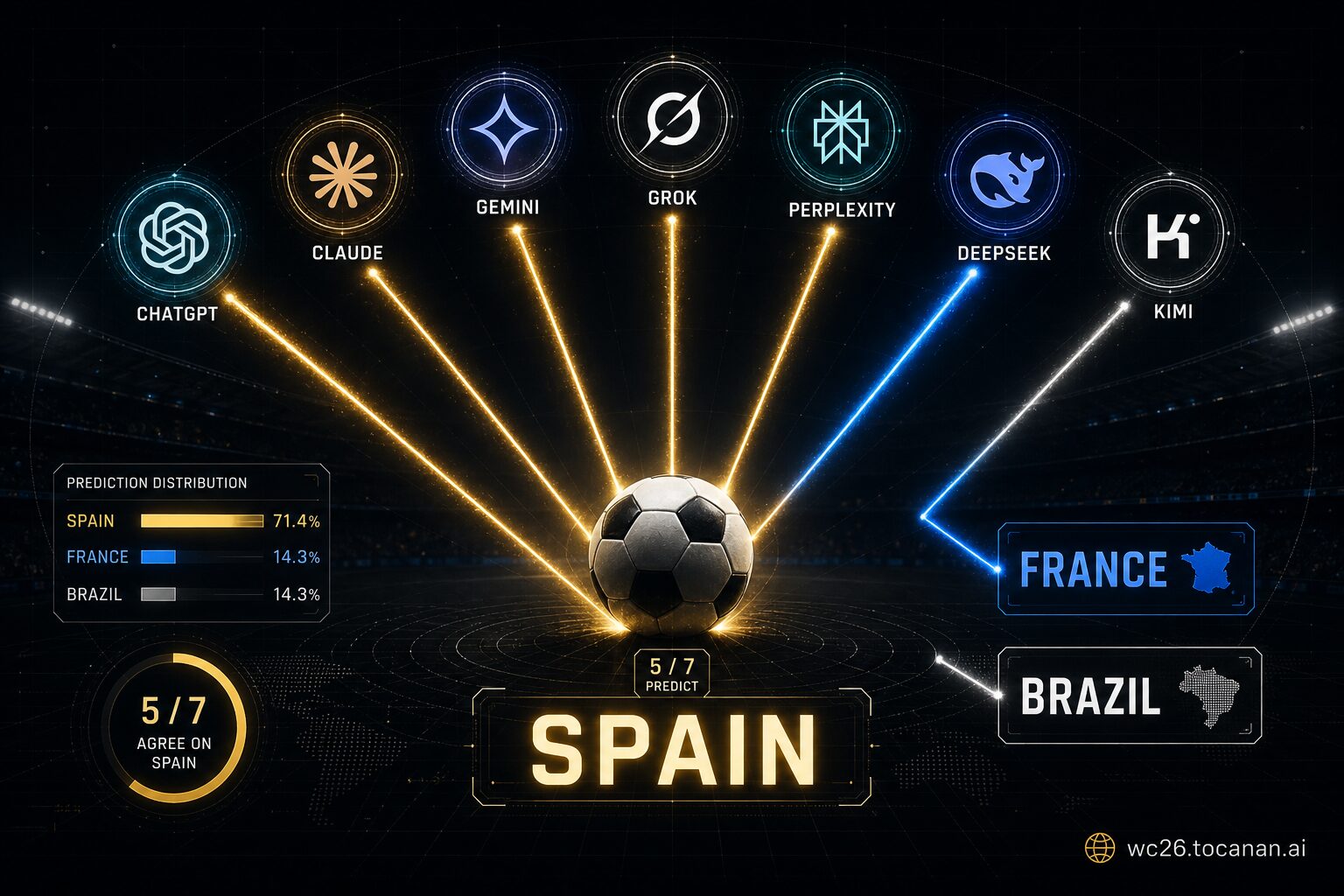
I asked seven AI platforms who’ll win the biggest football tournament of the summer. Five said Spain. One said France. One said Brazil. Same question, same day, same real-time data.
The average divergence across all our tracked questions is 58 out of 100 — where 0 means perfect agreement and 100 means total chaos.
That disagreement is the entire point.
The build
I’ve built a system that queries ChatGPT, Claude, Gemini, Grok, Perplexity, DeepSeek, and Kimi — each through its own real-time web search — so every model answers from today’s news, not last year’s training data. Their answers feed a consensus engine that doesn’t just count votes: it weighs each platform’s stated confidence against its trailing accuracy, so the ensemble learns who to trust as the tournament unfolds.
The integrity rules are strict — every prediction locks at kickoff. No model gets credit for “predicting” a result it could simply look up.
Everything goes on a public accuracy leaderboard at wc26.tocanan.ai, including the consensus itself, scored under the same rules as the individual platforms. The hypothesis, borrowed from decades of forecasting research: a well-weighted ensemble should beat its best member. By the final on July 19, we’ll know.
Full disclosure: the system was itself built with AI — specifically Anthropic’s Claude Fable 5 for the consensus weighting, integrity rules, and retrieval architecture.
Why a marketing person is doing forecasting science
Because the divergence is the story.
If seven AI platforms, given the same question on the same day, return different answers about a football match — what do you think they’re saying about your company?
We ran a similar exercise for a leading brand. ChatGPT recommended them by name. Gemini didn’t mention them at all. Same category, same query, two completely different realities. That brand had spent twenty years optimising for one search engine and was invisible across the new ones.
When a prospect asks ChatGPT “what’s the best [your category] tool?”, that answer is a prediction too. It’s assembled the same way: retrieval, weighting, synthesis. And it diverges across platforms just as wildly as the picks in that cover image. Most brands have never once checked.
That’s the discipline we work on at Tocanan.ai: GEO — generative engine optimisation. This tracker is the public proof that platform divergence is real, measurable, and consequential. The leaderboard isn’t a scoreboard; it’s evidence.
Follow the experiment
The machine runs daily, so the updates will too:
wc26.tocanan.ai — the live arena, updated daily: every prediction, the consensus, the divergence index, and the accuracy leaderboard as results come in. Bookmark it.
A weekly deep-dive every Monday: accuracy rankings, what the consensus engine learned, and what it means for how AI platforms talk about brands.
Both will carry the numbers exactly as they land — the hits and the misses, the leaderboard unedited. An experiment that hides its failures isn’t an experiment; it’s an ad. For the fuller 1,823-prediction GEO thesis behind this public test, read What 1,823 AI Predictions Taught Me About GEO.
And if you want to see what the seven oracles currently say about your brand, that audit takes five minutes: audit.tocanan.ai
Related reading
- Google AI Overview: How Citation Surfaces Work in 2026
- GEO Poisoning: Protecting Your Brand in AI Search
Related reading
AI Had a Blind Spot. I Fixed It with One Line of Prompt.
Frequently Asked Questions
What is AI prediction divergence?
AI prediction divergence measures how much different AI platforms disagree when asked the same question. Our tracker queries seven leading AI platforms daily and calculates a divergence index from 0 (perfect agreement) to 100 (total disagreement). The same divergence exists when AI platforms answer questions about brands, products, and services.
How does Generative Engine Optimization (GEO) work?
GEO is the practice of optimising how your brand appears in AI-generated answers across platforms like ChatGPT, Gemini, Perplexity, Claude, and others. Unlike traditional SEO which targets one search engine, GEO ensures your brand is visible, accurate, and recommended across all major AI platforms simultaneously.
Do AI platforms agree on football predictions?
No — our daily tracking shows an average divergence of 58/100 across seven AI platforms answering identical football prediction questions. Each platform retrieves different sources, weights information differently, and arrives at different conclusions. This same inconsistency applies to how AI platforms describe brands and recommend products.
About the Author
Eden Lau is CEO of Tocanan.ai, a GEO intelligence company that tracks how AI platforms represent brands across ChatGPT, Gemini, Perplexity, Claude, Grok, DeepSeek, and Kimi. With 30+ years in marketing data strategy, he previously co-founded Brandtology. Connect on LinkedIn.
The post I Asked 7 AI Platforms the Same Football Prediction. Five Said Spain. Two Disagreed. Your Brand Has the Same Problem. appeared first on Tocanan.
]]>The post Google AI 概覽五大全新引用介面:對品牌 GEO 策略的意義 appeared first on Tocanan.
]]>
發佈日期:2026 年 5 月 12 日 | 作者:Eden Lau,Tocanan.ai 創辦人暨行政總裁
2026 年 5 月 6 日,Google 宣佈五項全新方式,讓 AI 概覽 (AI Overviews) 及 AI Mode 在搜尋結果中呈現網站連結。這篇由 Google 搜尋產品管理副總裁 Hema Budaraju 撰寫的公告,傳遞出重要訊號:面對 AI 概覽壓縮網站流量的批評,Google 選擇創造更多引用介面,而非減少。
對於投資生成引擎優化 (GEO) 的品牌而言,這不僅是產品更新,更是 AI 引用版圖的結構性擴張——改變了品牌能見度的獲取方式、呈現形式,以及至關重要的一點——Google 自身工具仍然無法衡量的領域。
以下是本次公告的內容、意義,以及你現在應該採取的行動。
背景:AI 概覽已成為搜尋體驗的主流介面
在分析五項新介面之前,規模至關重要。
截至 2026 年 4 月,AI 概覽已出現在 48% 的 Google 搜尋查詢中——較一年前的 31% 大幅成長(BrightEdge 數據)。Google 報告指出,每月 20 億使用者與搜尋中的 AI 生成回覆互動。
這已不再是實驗。對於近半數搜尋查詢而言,AI 概覽就是主流搜尋介面。
對傳統自然搜尋結果的影響已有充分記錄:
- 當 AI 概覽出現在傳統結果上方時,自然點擊率下降 34.5%–61%
- 然而,在 AI 概覽中被引用的品牌,點擊率比未被引用的競爭對手高出 35%
- AI 引薦訪客的轉換率是傳統自然搜尋訪客的 4.4 倍(14.2% vs 2.8%)
訊息很明確:出現在 AI 概覽中,現在比在傳統搜尋結果中排名第一更有價值。但達成這個目標的路徑——以及如何維持——剛剛發生了改變。
五大全新引用介面:Google 的公告內容
1.「探索新角度」— 延伸探索連結
內容說明:在 AI 概覽回覆的底部,Google 現在展示精選連結,指向針對查詢主題不同面向的深度分析文章。這些不是泛泛的「相關搜尋」——而是經過編輯權重篩選的連結,指向具備主題深度和權威性的內容。
Google 的定位:這些連結幫助使用者「探索新角度」,將他們與提供原創分析、獨特觀點和全面報導的出版商連結起來。
重要性:這是首個明確獎勵主題權威性的 AI 概覽介面。Google 正透過演算法識別超越表面答案的內容,並在 AI 回覆之後給予顯著的連結位置——正是使用者想要深入了解的時刻。
2.「輕鬆存取你的新聞訂閱」— 訂閱連結
內容說明:當使用者擁有新聞出版商的付費訂閱時,AI 概覽會在回覆中直接突顯這些出版物的內容,並標示訂閱指標。
Google 的數據:「使用者明顯更傾向點擊標示為其訂閱的連結」——這句直接引述自公告,確認標籤確實驅動互動。
重要性:Google 正在建立基於使用者行為的引用偏好層。訂閱出版物獲得優先能見度——實質上是一個隨時間複利增長的信任訊號。
3.「聽取過來人的建議」— 社群建議面板
內容說明:AI 概覽中的專屬面板,呈現來自 Reddit、論壇、社群媒體平台及其他第一手來源的觀點。關鍵是,這些面板顯示創作者姓名、帳號名稱和社群名稱——而非僅是匿名摘錄。
重要性:這代表 Google 正式將使用者生成內容 (UGC) 和社群討論納入 AI 引用架構。它不再被埋藏在傳統結果下方的「討論與論壇」區塊——而是出現在 AI 回覆內部。
4.「在需要的地方直接看到連結」— 擴展行內連結
內容說明:更多引用連結直接嵌入 AI 回覆文本中,位於相關要點、陳述和論點旁邊。此前,AI 概覽將引用集中在側邊欄或頁尾。現在,行內連結遍佈回覆主體。
重要性:這是意圖最高的引用介面。使用者在閱讀特定論點時,看到旁邊的連結,點擊的可能性遠高於瀏覽底部來源列表的使用者。更多行內引用位置意味著更多機會——也意味著每個位置的競爭更加激烈。
5.「了解更多連結網站的背景」— 網站懸停預覽
內容說明:當使用者將滑鼠懸停在 AI 概覽中的行內連結上時,會出現預覽卡片,顯示網站名稱和頁面標題。這讓使用者在點擊前了解來源背景。
重要性:你的品牌名稱和頁面標題現在在 AI 回覆體驗中可見——即使使用者從未點擊。這是在 AI 媒介發現點上的環境品牌能見度。
各介面對你的 GEO 策略的意義
五項介面不需要五套獨立策略。它們強化一個連貫的 GEO 方法——但各有具體的戰術意涵。
延伸探索連結 → 投資主題深度
「探索新角度」功能獎勵超越即時問題的內容。這意味著:
- 支柱內容和主題群組現在直接獲得顯著的 AI 引用位置獎勵
- 原創分析、專有數據和獨特框架是差異化因素——而非堆砌關鍵字的清單文章
- 從多角度呈現主題的內容(比較分析、優缺點、趨勢評論)在演算法上受到偏好
💡 行動建議:審視你的內容庫的主題深度。如果你對某個主題的覆蓋很淺——競爭對手有十篇文章而你只有一篇——在這個介面上你是隱形的。圍繞核心主題建立全面的內容中心。
訂閱連結 → 爭取出現在你的受眾閱讀的出版物中
這個介面直接惠及擁有訂閱模式的出版商。對品牌而言,間接影響強大:
- 在訂閱出版物中的媒體曝光現在具有複合引用價值——每位訂閱者都會讓該文章獲得優先 AI 能見度
- 公關策略需要瞄準你的受眾實際付費訂閱的出版物,而不僅是網域權威度高的出版物
- 思想領袖專欄、署名文章和專家引述在訂閱媒體中成為 GEO 資產,而不僅是品牌知名度操作
💡 行動建議:找出你的目標受眾訂閱了哪些出版物。優先安排在那些媒體中的媒體曝光、專家來源關係和思想領袖內容。這是 GEO 與傳統公關的交匯點。
社群建議 → 建立真實的社群存在感
社群建議面板是 Google 迄今最明確的訊號——真實的社群參與對 AI 能見度至關重要:
- Reddit、Quora 和專業論壇現在是 AI 概覽內部的引用來源——而不僅是次要的排名訊號
- 創作者署名(姓名、帳號、社群名稱)意味著品牌代表和專業人士可以建立可識別的存在感
- 灌水和假帳號在演算法上將與真正的社群參與者區分開來——Google 展示的是誰說的,而不僅是說了什麼
💡 行動建議:制定獨立於內容行銷策略的社群參與策略。找出你的受眾在哪些 Reddit 社群、論壇和社群平台上提問。以專業知識真實參與。
擴展行內連結 → 結構化、有據可查的內容勝出
更多行內引用位置意味著更多被引用的機會——但每個位置的競爭也更激烈:
- 以數據、引用和第一手來源支持的論點,比無佐證的斷言更有可能獲得行內連結
- 內容結構比以往更重要——清晰的標題、要點和組織良好的資訊,讓 AI 系統更容易識別可引用的段落
- 時效性是一個因素:3 個月內的內容被 AI 概覽引用的可能性高出 3 倍。發佈後不管的策略是能見度的死刑
💡 行動建議:為可引用性而結構化內容。每個重要論點都應有數據支持。使用清晰的標題和邏輯組織。持續穩定發佈。
懸停預覽 → 品牌識別出現在發現節點
網站懸停預覽讓你的網站名稱和頁面標題無需點擊即可見。這改變了 AI 能見度的經濟學:
- 頁面標題現在是品牌曝光——即使使用者不點擊,他們也能看到你的品牌名稱和頁面標題
- 描述性、以利益為導向的頁面標題表現優於通用標題
- 跨網域一致的網站命名和品牌呈現,在 AI 回覆體驗中建立品牌認知
💡 行動建議:審查你的頁面標題和網站名稱在懸停預覽中的呈現效果。它們清晰嗎?是否傳達價值?是否強化你的品牌?將每個 meta 標題視為 Google AI 回覆內部的微型看板。
歸因缺口:房間裡的大象
Google 的公告描述了五種在 AI 概覽中呈現網站內容的新方式。它沒有解決的——也是品牌面臨的關鍵缺口——是衡量問題。
Google 仍然為 AI 概覽引用提供零點擊歸因。Google Analytics 和 Google Search Console 都無法區分來自 AI 概覽的點擊和來自傳統自然搜尋結果的點擊。你無法看到:
- 你的品牌是否在 AI 概覽中被引用
- 哪些搜尋查詢觸發了對你內容的引用
- 你的 AI 引用產生了多少曝光或點擊
- 你的引用位置是否隨時間變化
- 你與競爭對手在 AI 引用份額上的比較
這不是疏忽。這是一個影響每個投資數位能見度的品牌的結構性缺口。
考慮這組數據:76% 的 AI 概覽引用來自已在自然搜尋前十名的頁面——但 46.5% 來自排名 50 名以外的頁面。如果你依賴傳統排名追蹤來了解你的 AI 能見度,你遺漏了近半幅圖景。
競爭態勢也很嚴峻:在 1,840 萬個索引網域中,僅有 274,455 個網域曾出現在 AI 概覽中。佔比 1.5%。如果你在其中,回報是不成比例的。如果你不在,你甚至不知道自己錯過了什麼。
⚠️ 這就是為什麼獨立的 GEO 監測不是可選項,而是基礎。
Tocanan 如何監測 Google 不會告訴你的數據
Tocanan 提供跨 AI 平台的獨立 GEO 監測,涵蓋正在重塑消費者發現品牌方式的各個平台——不僅僅是 Google。
我們追蹤引用存在、位置、情感和競爭份額,覆蓋以下平台:
- Google AI 概覽 (AI Overviews) — 包括本週公告的全新引用介面
- Perplexity AI — 成長最快的 AI 搜尋平台
- ChatGPT — 日益被用作研究和推薦引擎
- DeepSeek — 正在重塑全球 AI 競爭格局的中國 AI 平台
- Kimi (Moonshot AI) — 對於在中國及亞太區有業務的品牌至關重要
- Gemini — Google 的獨立 AI 助手
- Baidu Ernie (百度文心) — 中文市場能見度的必備平台
Google 擴展了引用方式。我們追蹤你是否被引用、在哪裡、頻率如何,以及這些指標的變化趨勢——跨越每個 AI 平台,而非僅限一個。
本週行動清單
Google 的公告帶來即時行動項目:
- 審視你的內容主題深度。你是否全面覆蓋了核心主題?還是存在競爭對手將會填補的空白?
- 檢視你的頁面標題和網站品牌。懸停預覽讓這些元素在 AI 回覆中可見——將它們視為品牌曝光。
- 評估你的社群存在感。你的受眾在哪裡討論你的行業?你是否以專業貢獻參與其中?還是缺席?
- 檢查你的發佈節奏。3 個月內的內容被引用的可能性高 3 倍。你的內容庫有多新鮮?
- 建立獨立的 AI 引用監測。Google 的新介面創造了更多引用機會——但 Google 仍不會告訴你是否成功把握了這些機會。你需要獨立的能見度數據。
現在行動的品牌——當競爭對手還在爭論 GEO 是否不同於 SEO 的時候——將建立隨時間複利增長的引用權威性。五項新介面擴大了競技場。你是否在場上,取決於你自己。
常見問題
什麼是 AI 概覽引用介面?
AI 概覽引用介面是 Google 在 AI 生成搜尋回覆中展示網站連結的具體方式。截至 2026 年 5 月,Google 推出了五種新引用介面:延伸探索連結、訂閱標籤連結、社群建議面板、擴展行內連結,以及網站懸停預覽。每種介面為品牌提供不同的方式出現在 AI 概覽中。
AI 概覽在 Google 搜尋中有多普遍?
截至 2026 年 4 月,AI 概覽出現在 48% 的 Google 搜尋查詢中,較一年前的 31% 大幅成長。Google 報告每月有 20 億使用者與 AI 概覽互動。對於許多查詢,AI 概覽是使用者看到的第一個元素——位於傳統自然搜尋結果之上。
AI 概覽引用真的能帶來點擊嗎?
是的。研究顯示,在 AI 概覽中被引用的品牌,點擊率比未被引用的競爭對手高出 35%。此外,透過 AI 引用到達的訪客轉換率是傳統自然搜尋訪客的 4.4 倍(14.2% vs 2.8%)。在 AI 概覽中被引用的價值日益超越傳統自然搜尋的頂級排名。
GEO 和 SEO 有什麼區別?
GEO(生成引擎優化)專注於優化你的品牌在 AI 生成回覆中的能見度,涵蓋 Google AI 概覽、ChatGPT、Perplexity 等平台。SEO 專注於在傳統搜尋結果中排名。雖然最佳實踐有重疊之處,但 GEO 需要不同的監測方法、不同的內容策略和不同的成功指標。了解更多 GEO 與 SEO 的區別。
Google Search Console 能追蹤 AI 概覽引用嗎?
不能。截至 2026 年 5 月,Google Search Console 和 Google Analytics 都無法區分來自 AI 概覽的點擊和來自傳統自然搜尋結果的點擊。Google 不提供 AI 概覽引用的歸因數據。這就是為什麼獨立的 GEO 監測工具對於希望了解其 AI 搜尋能見度的品牌而言不可或缺。
新的社群建議面板如何影響品牌策略?
Google 的社群建議面板呈現來自 Reddit、論壇和社群平台的觀點——並顯示創作者姓名和帳號。這意味著品牌需要超越自有內容的真實社群參與策略。在相關社群中以專業知識參與,現在可以在 AI 概覽內部獲得引用位置。
哪些類型的內容最容易在 AI 概覽中被引用?
新鮮(3 個月內的內容被引用的可能性高 3 倍)、結構清晰、有數據支持且主題全面的內容表現最佳。新的延伸探索介面特別獎勵深度分析和主題權威性。在 1,840 萬個索引網域中,僅有 274,455 個曾出現在 AI 概覽中——品質和相關性門檻很高。
AI 概覽中的懸停預覽會顯示我的品牌名稱嗎?
是的。Google 的網站懸停預覽功能在使用者懸停在 AI 概覽中的行內連結上時,顯示你的網站名稱和頁面標題。這意味著你的 meta 標題和網站品牌現在在 AI 回覆體驗中可見——即使使用者不點擊。
除了 Google,品牌還應該監測哪些 AI 平台的引用?
品牌應監測 Google AI 概覽、ChatGPT、Perplexity AI、Gemini,以及——根據市場曝光度——DeepSeek、Kimi 和 Baidu Ernie (百度文心) 等中國平台。每個平台有不同的引用機制,在一個平台上的能見度不保證在其他平台上的能見度。
如何檢查我的品牌是否出現在 AI 概覽中?
你可以在 audit.tocanan.ai 進行免費 GEO 審計,了解你的品牌在 Google AI 概覽、ChatGPT、Perplexity、DeepSeek 及其他 AI 搜尋平台上的引用情況——以及哪裡是盲區。由於 Google 不提供 AI 引用的原生歸因工具,獨立監測是追蹤你的 AI 搜尋能見度的唯一途徑。
Read this article in English
The post Google AI 概覽五大全新引用介面:對品牌 GEO 策略的意義 appeared first on Tocanan.
]]>The post Google’s 5 New AI Overview Citation Surfaces: What They Mean for Your Brand’s GEO Strategy appeared first on Tocanan.
]]>
Published: 12 May 2026 | Author: Eden Lau, Founder & CEO, Tocanan.ai
On May 6, 2026, Google announced five new ways that AI Overviews and AI Mode surface links to websites within Search. Written by Hema Budaraju, VP of Product Management at Google Search, the post signals something significant: Google is responding to criticism that AI Overviews suppress web traffic — by creating more citation surfaces, not fewer.
For brands invested in Generative Engine Optimization (GEO), this isn’t just a product update. It’s a structural expansion of the AI citation landscape that changes how visibility is earned, displayed, and — critically — still not measured by Google’s own tools.
Here’s what was announced, what it means, and what to do about it.
The Context: AI Overviews Are Now the Default Search Experience
Before examining the five new surfaces, the scale matters.
AI Overviews now appear on 48% of all Google queries as of April 2026 — up from 31% a year earlier (BrightEdge data). Google reports 2 billion monthly users interact with AI-generated responses in Search.
This is no longer an experiment. It’s the dominant search interface for nearly half of all queries.
The impact on traditional organic results is well-documented:
- Organic click-through rates drop 34.5–61% when an AI Overview appears above traditional results
- Yet brands cited within AI Overviews earn 35% more clicks than uncited competitors
- AI-referred visitors convert at 4.4x the rate of traditional organic visitors (14.2% vs 2.8%)
The message is clear: being in the AI Overview is now more valuable than ranking #1 in traditional results. But the path to getting there — and staying there — just changed.
The 5 New Citation Surfaces: What Google Announced
1. “Explore New Angles” — Further Exploration Links
What it is: At the bottom of AI Overview responses, Google now displays curated links to articles and in-depth analyses that explore different facets of the query topic. These aren’t generic “related searches” — they’re editorially weighted links to content that demonstrates topical depth and authority.
Google’s framing: These links help users “explore new angles” on topics surfaced in the AI response — connecting them with publishers who provide original analysis, unique perspectives, and comprehensive coverage.
Why it matters: This is the first AI Overview surface that explicitly rewards topical authority. Google is algorithmically identifying content that goes beyond surface-level answers and giving it prominent link placement after the AI response — the exact moment a user wants to go deeper.
2. “Easily Access Your News Subscriptions” — Subscription Links
What it is: When a user has paid subscriptions to news publishers, AI Overviews now highlight content from those publications directly within the response. These links are labeled with a subscription indicator.
Google’s data: “People were significantly more likely to click links that were labeled as their subscriptions” — a direct quote from the announcement that confirms labeling drives engagement.
Why it matters: Google is creating a citation preference layer based on user behavior. Subscribed publications get preferential visibility — effectively a trust signal that compounds over time.
3. “Get Advice from People Who Have Been There” — Community Advice Panels
What it is: Dedicated panels within AI Overviews that surface perspectives from Reddit, forums, social media platforms, and other firsthand sources. Critically, these panels display creator names, handles, and community names — not just anonymous excerpts.
Why it matters: This is Google formally elevating user-generated content (UGC) and community discourse into AI citation architecture. It’s not buried in a “Discussions and forums” section below traditional results — it’s inside the AI response.
4. “See Links Right Where You Need Them” — Expanded Inline Links
What it is: More citation links embedded directly within the AI response text, positioned next to relevant bullet points, statements, and claims. Previously, AI Overviews concentrated citations in a sidebar or footer. Now, inline links appear throughout the response body.
Why it matters: This is the highest-intent citation surface. A user reading a specific claim and seeing a link right beside it is far more likely to click than someone scanning a list of sources at the bottom. More inline citation slots means more opportunities — and more competition for each one.
5. “Get More Context on Linked Websites” — Website Hover Previews
What it is: When users hover over an inline link within an AI Overview, a preview card appears showing the site name and page title. This gives users context about the source before they click.
Why it matters: Your brand name and page titles are now visible within the AI response experience — even if the user never clicks through. This is ambient brand visibility at the point of AI-mediated discovery.
What Each Surface Means for Your GEO Strategy
The five surfaces don’t require five separate strategies. They reinforce a coherent GEO approach — but with specific tactical implications.
Further Exploration Links → Invest in Topical Depth
The “Explore new angles” feature rewards content that goes beyond answering the immediate question. This means:
- Pillar content and topic clusters are now directly rewarded with prominent AI citation placement
- Original analysis, proprietary data, and unique frameworks are the differentiators — not keyword-stuffed listicles
- Content that presents multiple angles on a topic (comparison analyses, pros/cons, trend commentary) is algorithmically favoured
Action: Audit your content library for topical depth. If your coverage of a topic is shallow — one blog post where competitors have ten — you’re invisible in this surface. Build out comprehensive content hubs around your core topics.
Subscription Links → Earn Placement in Publications Your Audience Reads
This surface benefits publishers with subscription models directly. For brands, the implication is indirect but powerful:
- Earned media in subscribed publications now carries compound citation value — the article gets preferential AI visibility for every subscriber
- PR strategy needs to target publications that your audience actually pays for, not just publications with high domain authority
- Thought leadership placements, bylined articles, and expert quotes in subscribed outlets become a GEO asset, not just a brand awareness play
Action: Identify which publications your target audience subscribes to. Prioritise earned media, expert sourcing relationships, and thought leadership placements in those outlets. This is where GEO and traditional PR intersect.
Community Advice → Build Authentic Community Presence
The Community Advice panel is Google’s clearest signal yet that authentic participation in communities matters for AI visibility:
- Reddit, Quora, and specialist forums are now citation sources inside AI Overviews — not just secondary ranking signals
- Creator attribution (names, handles, community names) means brand representatives and subject matter experts can build recognisable presence
- Astroturfing and sock-puppet accounts will be algorithmically distinguishable from genuine community participants — Google is showing who said it, not just what was said
Action: Develop a community engagement strategy that’s separate from your content marketing strategy. Identify the Reddit communities, forums, and social platforms where your audience asks questions. Participate authentically with expert knowledge. Don’t market — contribute.
Expanded Inline Links → Structured, Well-Sourced Content Wins
More inline citation slots mean more opportunities to be cited — but also more competition for each slot:
- Claims backed by data, citations, and primary sources are more likely to receive inline links than unsupported assertions
- Content structure matters more than ever — clear headings, bullet points, and well-organised information make it easier for AI systems to identify citable passages
- Freshness is a factor: content under 3 months old is 3x more likely to be cited in AI Overviews. A publish-and-forget strategy is a visibility death sentence.
Action: Structure content for citability. Every major claim should be supported with data. Use clear headings and logical organisation. Publish consistently — not quarterly “mega guides” that age out of citation eligibility.
Hover Previews → Brand Identity at the Point of Discovery
Website hover previews make your site name and page titles visible without a click. This changes the economics of AI visibility:
- Meta titles are now brand impressions — even when users don’t click through, they see your brand name and page title
- Descriptive, benefit-oriented page titles outperform generic ones (“How to Reduce Cloud Costs by 40% — Acme Analysis” vs “Cloud Cost Blog Post”)
- Consistent site naming and branding across your domain builds recognition within the AI response experience
Action: Audit your page titles and site name as they would appear in a hover preview. Are they clear? Do they communicate value? Do they reinforce your brand? Treat every meta title as a micro-billboard inside Google’s AI response.
The Attribution Gap: The Elephant in the Room
Google’s announcement describes five new ways to surface web content within AI Overviews. What it doesn’t address — and what remains the critical gap for brands — is measurement.
Google still provides zero click-through attribution for AI Overview citations. Neither Google Analytics nor Google Search Console distinguishes between clicks from AI Overviews and clicks from traditional organic results. You cannot see:
- Whether your brand was cited in an AI Overview
- Which queries triggered citations to your content
- How many impressions or clicks your AI citations generated
- Whether your citation position changed over time
- How you compare to competitors in AI citation share
This isn’t an oversight. It’s a structural gap that affects every brand investing in digital visibility.
Consider the data: 76% of AI Overview citations come from pages already in the Top 10 organic results — but 46.5% come from pages outside the top 50. If you’re relying on traditional rank tracking to understand your AI visibility, you’re missing nearly half the picture.
And the competitive landscape is stark: only 274,455 domains have appeared in AI Overviews out of 18.4 million indexed domains. That’s 1.5%. If you’re in, the rewards are disproportionate. If you’re out, you don’t even know what you’re missing.
This is why independent GEO monitoring isn’t optional. It’s foundational.
How Tocanan Monitors What Google Won’t Show You
Tocanan provides independent GEO monitoring across the AI platforms that are reshaping how consumers discover brands — not just Google.
We track citation presence, position, sentiment, and competitive share across:
- Google AI Overviews — including the new citation surfaces announced this week
- Perplexity AI — the fastest-growing AI search platform
- ChatGPT — increasingly used as a research and recommendation engine
- DeepSeek — the Chinese AI platform reshaping global AI competition
- Kimi (Moonshot AI) — critical for brands with China/Asia-Pacific exposure
- Gemini — Google’s standalone AI assistant
- Baidu Ernie — essential for Chinese-language market visibility
Google has expanded how it cites. We track whether you’re cited, where, how often, and how that’s changing — across every AI platform, not just one.
Is Your Brand Visible in AI Search?
Run a free GEO audit to see where your brand appears — and where it’s invisible — across AI search platforms.
What to Do This Week
Google’s announcement creates immediate action items:
- Audit your content for topical depth. Do you have comprehensive coverage of your core topics, or are there gaps competitors will fill?
- Review your page titles and site branding. Hover previews make these visible inside AI responses — treat them as brand impressions.
- Assess your community presence. Where does your audience discuss your industry? Are you there with expert contributions, or absent?
- Check your publishing cadence. Content under 3 months old is 3x more likely to be cited. How fresh is your content library?
- Establish independent AI citation monitoring. Google’s new surfaces create more citation opportunities — but Google still won’t tell you whether you’re capturing them. You need independent visibility data.
The brands that act on this now — while competitors are still debating whether GEO is different from SEO — will build citation authority that compounds over time. The five new surfaces expand the playing field. Whether you’re on it is up to you.
Frequently Asked Questions
What are AI Overview citation surfaces?
AI Overview citation surfaces are the specific ways Google displays links to websites within AI-generated search responses. As of May 2026, Google has introduced five new citation surfaces: Further Exploration links, subscription-labeled links, Community Advice panels, expanded inline links, and website hover previews. Each surface gives brands a different way to appear within AI Overviews.
How common are AI Overviews in Google Search?
AI Overviews now appear on 48% of all Google queries as of April 2026, up from 31% a year earlier. Google reports 2 billion monthly users interact with AI Overviews. For many queries, the AI Overview is the first thing users see — above traditional organic results.
Do AI Overview citations actually drive clicks?
Yes. Research shows that brands cited in AI Overviews earn 35% more clicks than uncited competitors. Additionally, visitors arriving via AI citations convert at 4.4x the rate of traditional organic visitors (14.2% vs 2.8%). Being cited in an AI Overview is increasingly more valuable than a top organic ranking.
What is the difference between GEO and SEO?
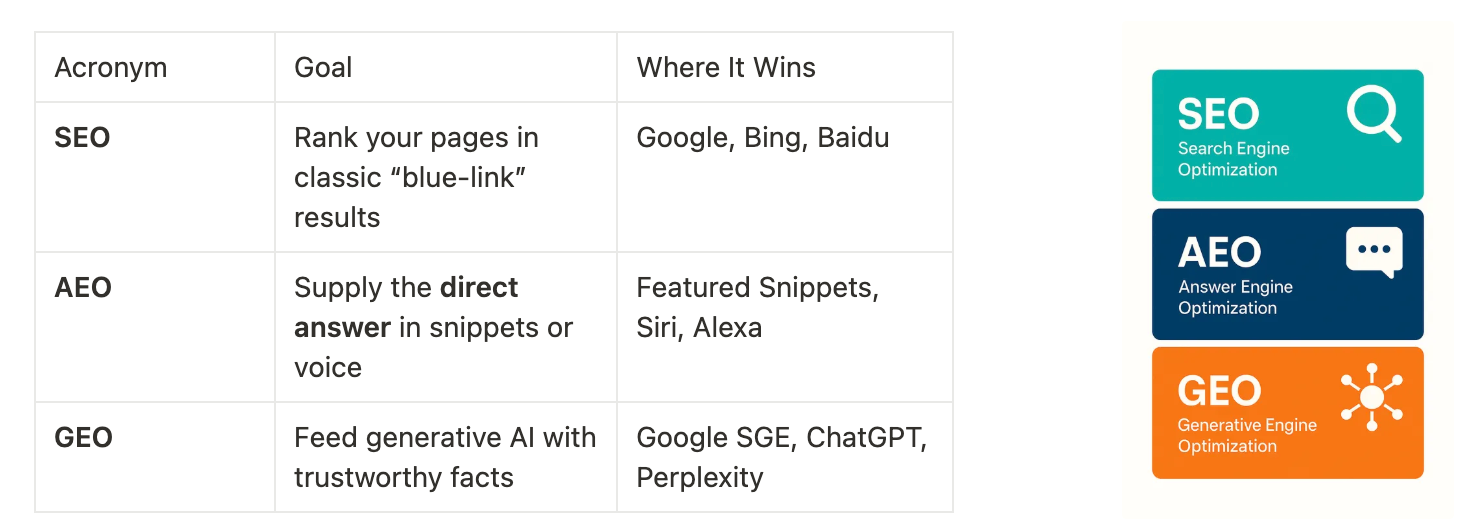
GEO (Generative Engine Optimization) focuses on optimising your brand’s visibility within AI-generated responses across platforms like Google AI Overviews, ChatGPT, Perplexity, and others. SEO focuses on ranking in traditional search results. While there’s overlap in best practices, GEO requires different monitoring, different content strategies, and different success metrics. Learn more about how GEO differs from SEO.
Can Google Search Console track AI Overview citations?
No. As of May 2026, neither Google Search Console nor Google Analytics can distinguish between clicks from AI Overviews and clicks from traditional organic results. Google provides no native attribution data for AI Overview citations. This is why independent GEO monitoring tools are essential for brands that want to understand their AI search visibility.
How do the new Community Advice panels affect brand strategy?
Google’s Community Advice panels surface perspectives from Reddit, forums, and social platforms — with creator names and handles displayed. This means brands need authentic community engagement strategies that go beyond owned content. Participating in relevant communities with expert knowledge can now earn citation placement inside AI Overviews.
What types of content are most likely to be cited in AI Overviews?
Fresh (content under 3 months old is 3x more likely to be cited), well-structured, data-backed, and topically comprehensive content performs best. The new Further Exploration surface particularly rewards in-depth analysis and topical authority. Out of 18.4 million indexed domains, only 274,455 have appeared in AI Overviews — the quality and relevance bar is high.
Do hover previews in AI Overviews show my brand name?
Yes. Google’s website hover preview feature displays your site name and page title when users hover over inline links in AI Overviews. This means your meta titles and site branding are now visible within the AI response experience — even if users don’t click through.
Which AI platforms should brands monitor for citations beyond Google?
Brands should monitor Google AI Overviews, ChatGPT, Perplexity AI, Gemini, and — depending on market exposure — Chinese platforms including DeepSeek, Kimi, and Baidu Ernie. Each platform has different citation mechanics, and visibility on one doesn’t guarantee visibility on others.
How can I check if my brand appears in AI Overviews?
You can run a free GEO audit at audit.tocanan.ai to see where your brand is cited across Google AI Overviews, ChatGPT, Perplexity, DeepSeek, and other AI search platforms — and where you’re invisible. Since Google provides no native attribution tools for AI citations, independent monitoring is the only way to track your AI search visibility.
Read this article in 繁體中文
The post Google’s 5 New AI Overview Citation Surfaces: What They Mean for Your Brand’s GEO Strategy appeared first on Tocanan.
]]>The post From SEO to AEO & GEO: How to Stay Visible in AI-Powered Search appeared first on Tocanan.
]]>
Search is changing at warp speed. Five years ago your biggest worry was landing on Google’s first page. Today your customers get instant answers from ChatGPT, Google’s AI Overviews, Bing Copilot, Siri, or Alexa—often without clicking a single link. If those machines don’t quote your content, your brand disappears from the conversation.
Why SEO Alone Won’t Save You
- Zero-click reality. Over half of Google queries now end without a website visit because an answer box or AI summary satisfies the user.
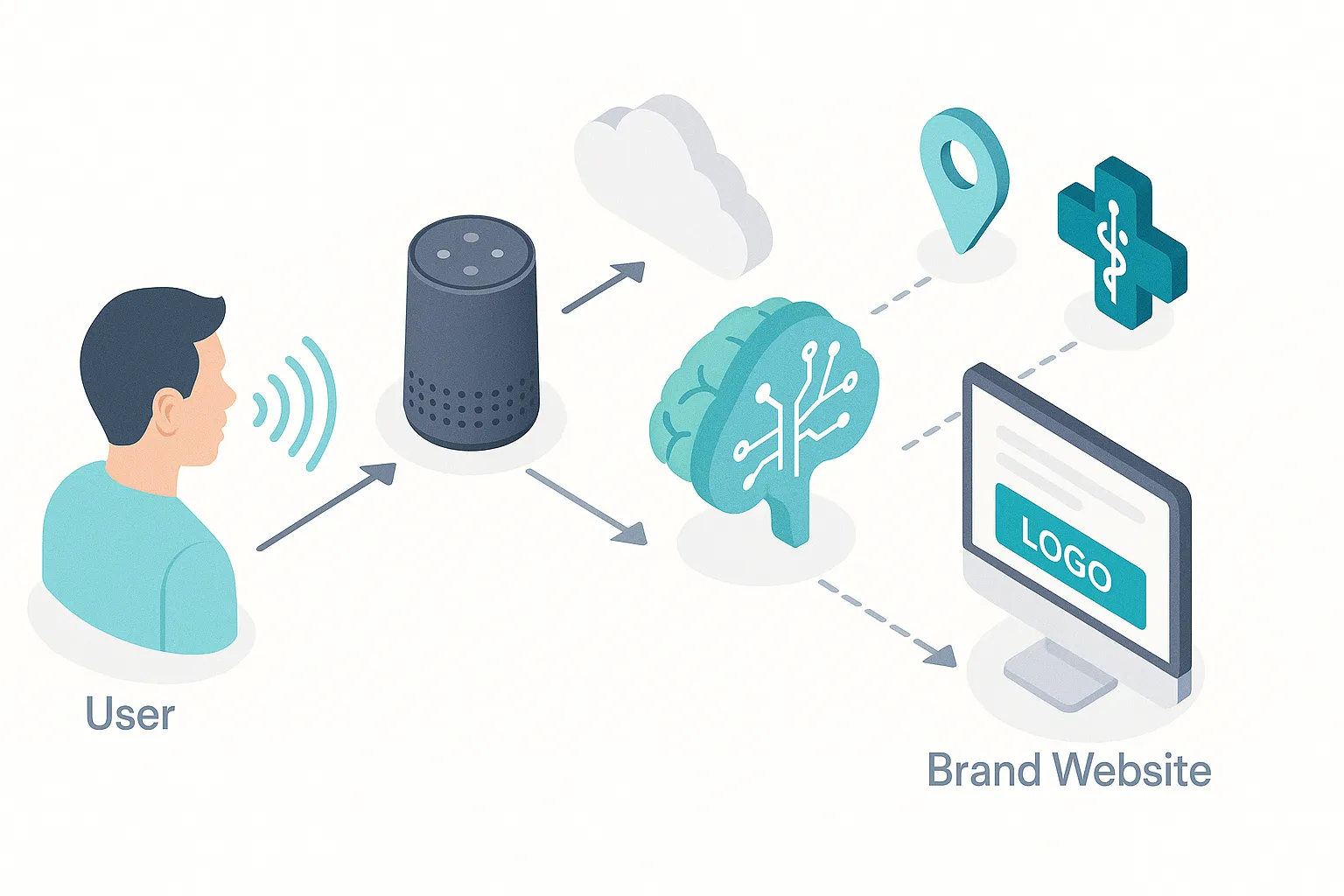
- Voice is mainstream. Voice searches account for roughly 50 % of all mobile queries. Voice assistants read one answer—not ten links.
- Generative AI growth. ChatGPT handles tens of millions of questions daily and usually cites only a few sources. Miss that shortlist and you’re invisible.
Ignoring AEO and GEO is a fast track to declining traffic, fewer leads, and ceded authority. Early adopters, on the other hand, are already capturing share of voice in AI answers—often at the expense of slower competitors.
A Unified Playbook for SEO + AEO + GEO
- Start with real questions. Mine “People Also Ask,” forums, social chatter, and your support inbox to discover exactly how buyers phrase problems. Build content around those long-tail queries.
- Answer first, elaborate second. Open each article with a crisp 1-3 sentence takeaway—the perfect snippet for Google or voice assistants—then dive into detail for generative AI to chew on.
- Structure like a pro. Use descriptive H2/H3 headings, bullet lists, tables, and FAQ sections. Add schema markup (FAQ, How-to, Product) so both search bots and AI crawlers instantly grasp context.
- Prove authority. Cite reputable sources, highlight expert authors, and earn mentions from trusted sites. Authority signals raise your odds of being selected by AI as the “safe” answer.
- Monitor AI visibility. Track which pages surface in Google’s AI Overviews or Bing Chat. Refine content that isn’t getting picked up, and keep an eye on robots.txt so you’re not blocking AI crawlers like GPTBot.
Industry Spotlights
Travel & Hospitality: Win the Recommendation
A family planning a beach holiday might:
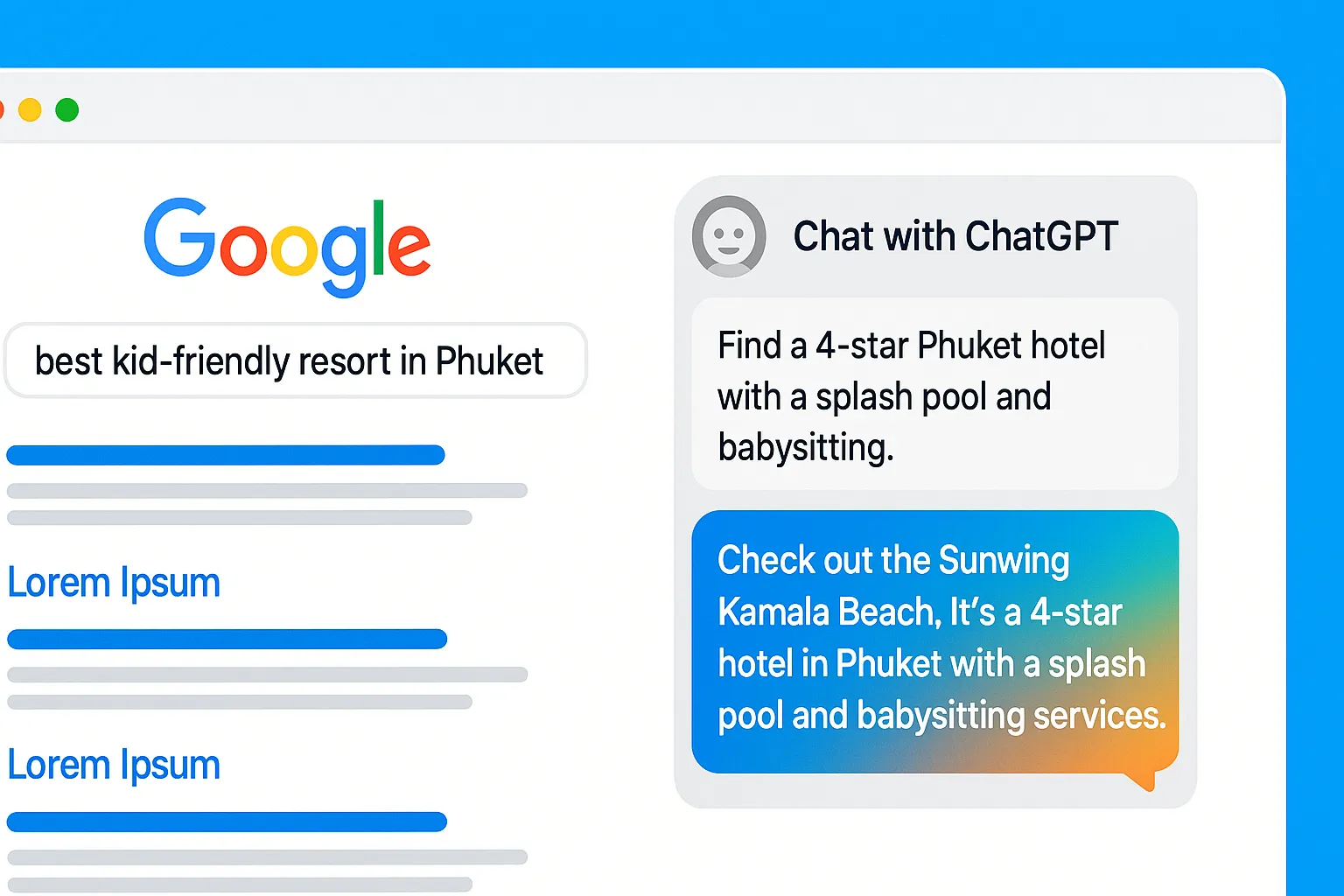
- Google: “best kid-friendly resort in Phuket”
- Ask Alexa: “Which Phuket resort has a kids’ club?”
- Chat with Bing AI: “Find a 4-star Phuket hotel with a splash pool and babysitting.”
If your site hosts a scannable FAQ—“Yes, our Splash Bay Kids’ Club offers full-day childcare”—Alexa can read it verbatim. If your blog details the splash pool, Bing AI can weave that into its answer and link to you. Without that structured intel, a third-party OTA or rival resort will own the conversation—and probably the booking.
Healthcare & Wellness: Own Trust and Accuracy
Patients increasingly ask AI tools for guidance:
- “How do I treat mild eczema at home?”
- “Is melatonin safe for teens?”
- “Top physiotherapists near me.”
Clinics that publish expert-reviewed, well-formatted content become the sources AI trusts. A dermatology practice that lists five dermatologist-approved home remedies can land the featured snippet and feed ChatGPT’s response. Failing to optimise leaves room for less reliable sources to set the narrative, risking both patient outcomes and your brand authority.
Tocanan’s Edge
Tocanan sits at the crossroads of advanced AI content creation and deep consumer insight—specialized in both English and Chinese. Our platform:
- Surfaces the exact questions audiences ask online and even to your call-centre agents in each market.
- Generates expert-level content structured for SEO, AEO, and GEO in one pass.
Whether you’re a global hotel group targeting Western travellers, a wellness brand educating mainland Chinese consumers, or a B2B SaaS firm chasing multilingual leads, we tailor optimisation that speaks human and machine fluently.
The new optimisation triad of SEO, AEO, and GEO is mission-critical for brands to maintain visibility in AI-driven search environments.
Ready to Own the AI Answer Space?
The search landscape is already ruled by snippets, summaries, and smart assistants. Let’s make sure your brand is the one they quote.
Book a free AI-Search Visibility Consultation with Tocanan.
Don’t settle for being another link. Be the answer.
Schedule a call or contact us at hello@tocanan.com
Discover how Tocanan’s GEO services can help your brand navigate this transition from SEO to GEO. For a comprehensive overview, read our complete guide to Generative Engine Optimization. 本文亦提供中文版。
Frequently Asked Questions
What is GEO in simple terms?
How to measure brand visibility in AI search?
Which dashboards track AI search visibility?
What metrics for AI search visibility?
How to improve citation rate in AI responses?
What risks if brands ignore AI search?
Predict what questions AI platforms will surface next with GEO Foresight.
The post From SEO to AEO & GEO: How to Stay Visible in AI-Powered Search appeared first on Tocanan.
]]>The post Guide To Maximize ChatGPT Search and Social Monitoring for Marketing Insights appeared first on Tocanan.
]]>
OpenAI launched the search functionality within ChatGPT on October 31, 2024, introducing a powerful tool ChatGPT Search for information gathering and understanding. However, to truly harness its potential, marketers and analysts should view it as a complement rather than a replacement for specialized AI-powered market and consumer insight tools. In this article, we’ll explore the features of ChatGPT Search and how combining it with specialized insights tools can help elevate your marketing strategies and data analysis.
ChatGPT Search: A Game-Changer for Broad Information Gathering
ChatGPT Search leverages the power of OpenAI’s language models, providing users with immediate access to an extensive knowledge base. It is an effective tool for marketers and analysts who need to quickly gather broad, up-to-date information from across the web—something beyond what typical search engines offer. From identifying trending topics to performing high-level competitor analysis, ChatGPT Search excels in making initial explorations accessible and convenient.
For instance, a marketer aiming to understand general industry trends or consumer sentiment on a new product can use ChatGPT Search to gather recent news articles, blog posts, and other publicly available data with citations. This broad-spectrum data helps users get an overview of the market and set the direction for deeper analysis.
However, while ChatGPT Search provides an excellent overview, it often lacks the depth and nuance that specialized consumer insights tools offer. This is where tools like those provided by Tocanan come into play.
Going Beyond Search: The Power of Nuanced Insights
Your AI-powered consumer insights tools are designed to dive deeper, providing a level of specificity and context that sets them apart from ChatGPT Search. While ChatGPT Search can gather and summarize information, specialized insights tools go further—analyzing complex data patterns, identifying nuanced trends, and offering contextually rich analysis tailored to the needs of marketers and analysts.
Consider the feature comparison below to understand the different roles that ChatGPT Search and AI-powered tools can play:
| Feature | ChatGPT Search | AI-Powered Tools |
|---|---|---|
| Information Gathering | Broad, up-to-date information | Deep, industry-specific analysis |
| Industry-specific Analysis | General insights and context | Comprehensive, contextual insights |
| Latest Data Access | Access to the up-to-data and trends | Latest social media trends |
| Nuanced Insights | Basic insights based on search queries | Multi-attribute sentiment analysis and insights |
| Keyword Optimization | Identify trending keywords | Advanced consumer intent analysis |
| Competitor Analysis | Gather publicly available competitor information | Refined competitive intelligence |
| Content Creation | Identify trending topics | Data-driven content strategies |
| Market Segmentation | Identify broad segments | Detailed consumer segmentation |
| Sentiment Analysis | Basic sentiment extraction | Nuanced sentiment understanding |
Table 1: Comparison table showing the differences between ChatGPT Search and AI-Powered Tools
Use Cases: When to Use ChatGPT Search vs. Specialized AI Tools
1. Initial Exploration vs. Deep Dive Analysis
When starting a new project, it’s essential to have a foundational understanding of the industry, target audience, or current events. ChatGPT Search is ideal for these initial explorations. It can provide broad insights into market dynamics, emerging trends, and consumer behaviors—giving analysts a starting point.
However, when the goal is to extract granular details, such as understanding consumer behavior at a deeper level, uncovering sentiment across different attributes, or developing a comprehensive brand perception report, specialized AI-powered consumer insights tools are needed. Tocanan’s AI tools enable precise multi-attribute sentiment analysis, providing clarity that helps marketers identify not just “what” is happening but “why.”
2. Trending Keywords vs. Search Intent Analysis
ChatGPT Search can help marketers stay current by identifying trending keywords and popular search terms. This feature is valuable for generating content ideas and ensuring your campaigns tap into the zeitgeist.
On the other hand, understanding the underlying search intent behind these keywords is key to creating successful, targeted campaigns. Tocanan’s tools offer advanced consumer intent analysis, ensuring that marketers not only see the trends but also understand what drives them. This leads to more relevant content that speaks directly to consumer needs and motivations.
3. Competitor Analysis: Public Data vs. Strategic Insights
ChatGPT Search provides easy access to publicly available information on competitors—such as their latest press releases or media coverage. It’s an excellent starting point to see how competitors are positioning themselves.
Tocanan’s consumer insights tools take it further, providing refined competitive intelligence that identifies competitor strategies across multiple dimensions—such as content performance, consumer sentiment, and social media trends. These insights help craft data-driven strategies that give your brand a competitive edge.
Leveraging Social Monitoring Tools for Latest Social Media Trends
Social media monitoring is one of the key strengths of Tocanan’s AI-powered solutions. Unlike ChatGPT Search, which is limited to information available on the web, Tocanan’s tools provide access to an abundant social media data. This feature is particularly useful for marketers and analysts seeking to understand how a topic is evolving in the moment—allowing for agile responses and timely content creation.
For instance, during major events or product launches, understanding real-time sentiment and engagement on platforms like Instagram or Xiaohongshu is crucial. Tocanan’s social monitoring tools provide metrics like engagement rates and content popularity, helping brands fine-tune their strategies on the fly.
Nuanced Sentiment Understanding
While ChatGPT Search offers basic sentiment extraction from the content it finds, understanding the subtleties behind customer sentiment requires more sophisticated tools. Tocanan’s AI-powered sentiment analysis capabilities go beyond simply identifying whether a sentiment is positive, negative, or neutral. Instead, they dig into the context—identifying specific attributes that affect sentiment and providing actionable insights.
For example, a social media post might be categorized as “positive” overall, but Tocanan’s AI could identify that while the customer loves a product’s design, they are dissatisfied with delivery times. Such detailed insights allow brands to make more targeted improvements.
Combining the Strengths of ChatGPT Search and Advanced Social Monitoring Tools
To maximize the value of these tools, it’s important to recognize that they serve different but complementary purposes. Marketers and analysts can leverage ChatGPT Search for its speed and breadth in information gathering while using Tocanan’s AI-powered social monitoring tools for depth, context, and actionable intelligence.
Consider an example campaign launch:
- Step 1: Use ChatGPT Search to gather broad market insights and identify trending themes related to the campaign topic.
- Step 2: Use Tocanan’s AI-Powered social listening to conduct detailed analysis—understand consumer sentiment, predict engagement trends, and identify specific audience segments most likely to engage with the campaign.
- Step 3: Combine the findings to build a data-driven content strategy that is relevant, timely, and highly targeted.
By combining these approaches, marketers can move quickly to understand the big picture while ensuring that every tactical decision is backed by in-depth analysis and precision targeting.
Conclusion: Getting the Best of Both Worlds
The newly launched ChatGPT Search is a welcome addition to the toolkit of marketers and analysts—its ability to gather and summarize broad information is valuable for initial research and direction setting. However, to truly capitalize on the power of AI, specialized consumer insights tools, like those offered by Tocanan, are indispensable.
These tools allow marketers to move beyond surface-level insights, providing the in-depth analysis needed to understand the true motivations of their audience and deliver impactful campaigns. By effectively leveraging both ChatGPT Search and advanced social monitoring tools, marketers can ensure they stay informed, agile, and deeply connected to their target audience.
Ready to elevate your marketing campaigns with comprehensive insights? Explore how Tocanan’s AI-powered consumer insights tools can transform your approach to business success.
About Us:
Tocanan provides market intelligence solution that analyses millions unstructured data points across various sources, from news to social media to e-commerce, to help marketers see tomorrow’s opportunities today.
We provide market intelligence solution with features like:
1. AI approach to unlocking marketing intelligence
2. Tailor
The post Guide To Maximize ChatGPT Search and Social Monitoring for Marketing Insights appeared first on Tocanan.
]]>The post OpenAI’s o1 Model: Advancing AI Reasoning and Sentiment Analysis appeared first on Tocanan.
]]>
OpenAI has once again pushed the boundaries with its latest innovation: the o1 model. This groundbreaking AI system represents a significant leap forward in artificial intelligence capabilities, particularly in the realms of advanced reasoning. As we delve into the intricacies of o1, we’ll explore its features, performance, and potential applications, with a special focus on how it compares to its predecessor, GPT-4o.
The Dawn of a New AI Era
OpenAI’s o1 model comes in two variants: o1-preview and o1-mini. Built upon a foundation of reinforcement learning, o1 introduces a novel approach to AI processing that emphasizes “thinking before responding.” This methodology allows the model to engage in more complex problem-solving and nuanced analysis, particularly in the fields of science, coding, and mathematics.
The o1 model’s architecture is designed to excel in tasks requiring advanced reasoning. By incorporating a more sophisticated understanding of context and relationships between concepts, o1 can tackle problems that were previously challenging for AI systems. This improvement is particularly evident in its performance across various academic and professional benchmarks.
Pushing the Boundaries: Performance Benchmark
To truly gauge the capabilities of o1, OpenAI subjected the model to a series of rigorous tests across different domains:
- Competitive Programming: o1 demonstrated exceptional performance on Codeforces, a platform renowned for its challenging algorithmic problems.
- Mathematics: The model excelled in the USA Math Olympiad qualifier (AIME) and showed promising results in the International Mathematics Olympiad (IMO) qualifying exam.
- Sciences: o1 tackled complex problems in Physics, Biology, and Chemistry through the General Physics Question Answering (GPQA) benchmark.
These benchmarks highlight o1’s ability to not only process information but to apply logical reasoning and problem-solving skills in highly specialized areas. The model’s performance in these tests suggests a significant advancement in AI’s capacity to handle complex, multi-step problems that require deep understanding and analytical thinking.
o1 vs. GPT-4o: A Comparative Analysis
One of the most intriguing aspects of o1 is how it compares to its predecessor, GPT-4o. To explore this, we conducted a comparative analysis on transcribed customer hotline voice logs with both models, focusing on issues pickup, sentiment detection, and proposing solutions to customer hotline interactions. The results revealed several key differences:
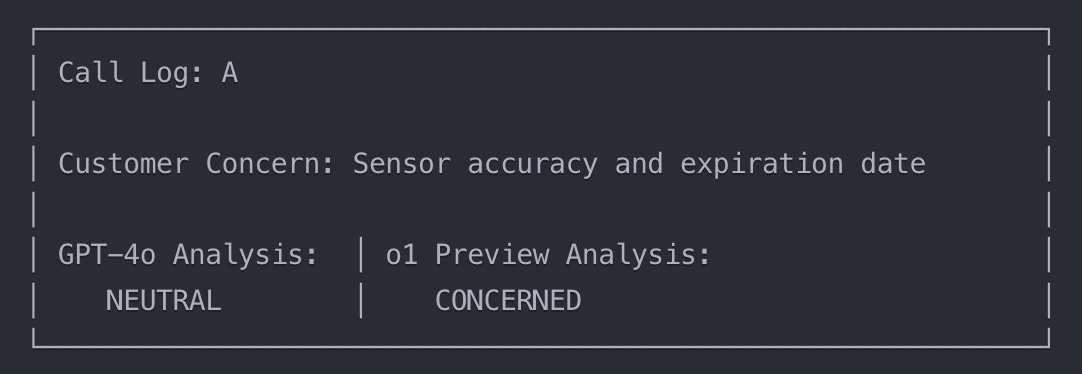
Illustration 1 : Sentiment analysis comparison: GPT-4o labels ‘Sensor accuracy’ concern as NEUTRAL, while o1-preview detects CONCERNED sentiment
Sentiment Analysis: A Leap Forward
- Nuanced Detection: o1-preview demonstrated a more refined ability to detect subtle emotional tones. In several instances where GPT-4o classified sentiments as “Neutral,” o1-preview identified more specific sentiments like “Concerned” and “Frustrated.”
- Enhanced Sensitivity: o1-preview appeared to be more sensitive to negative emotions overall, potentially leading to more accurate and detailed sentiment analysis.
Issue Identification: Unraveling Complex Problems
o1-preview’s nuanced analysis capabilities translate into better issue identification:
- Increased Sensitivity: The model’s ability to detect more subtle emotional states suggests it might be more adept at identifying underlying issues that aren’t immediately apparent.
- Improved Urgency Assessment: o1-preview’s more granular analysis could lead to better assessment of issue urgency, based on its improved detection of customer emotions like frustration or concern.
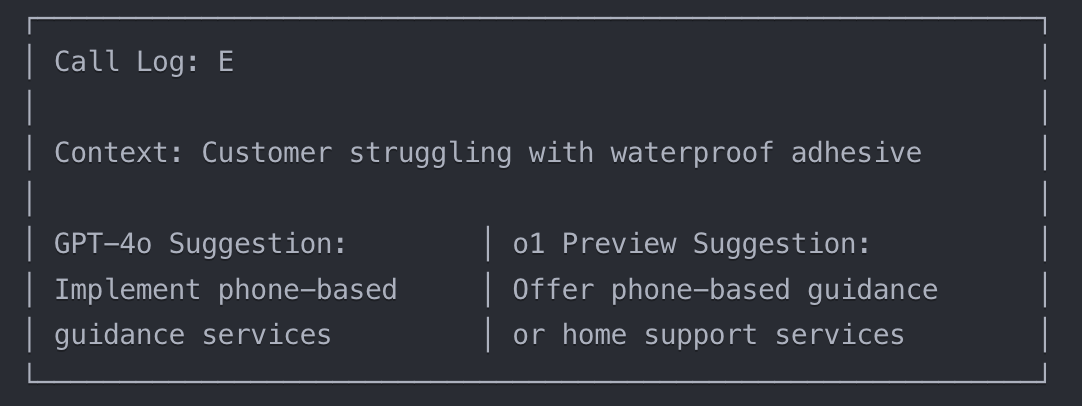
Solution Generation: Room for Improvement
Interestingly, despite o1-preview’s advanced capabilities, its performance in generating solutions doesn’t demonstrate significant improvements over GPT-4o:
- Broader Knowledge Base: While o1-preview is expected to have a more extensive general knowledge base, this doesn’t necessarily translate into more diverse or innovative solution suggestions.
- Similarity to GPT-4o: The solution suggestions from o1-preview often appear similar in quality and depth to those provided by GPT-4o, sometimes coming across as generic or cliché.
The Strengths and Challenges of o1
Key Strengths
- Complex Problem-Solving: o1’s performance in competitive programming and academic benchmarks demonstrates its advanced analytical capabilities.
- STEM Reasoning: The model excels in science, technology, engineering, and mathematics tasks, making it a powerful tool for research and education in these fields.
- Enhanced Sentiment Analysis: o1 demonstrates improved accuracy in detecting and classifying emotional tones in text, representing a significant advancement in AI’s ability to analyze human communication.
Limitations and Challenges
Despite its advancements, o1 faces some limitations:
- Feature Gaps: Current versions may lack some features present in other models, such as web browsing and file upload capabilities.
- Processing Speed: The model’s complex reasoning approach may result in slower response times for intricate queries.
- Cost Considerations: The advanced capabilities of o1 may come with higher operational costs, potentially impacting its accessibility and widespread adoption.
The Future of AI: Potential Applications
The unique capabilities of o1 open up exciting possibilities across various fields:
- Scientific Research: o1’s advanced reasoning could accelerate breakthroughs in complex scientific problems.
- Software Development: Its proficiency in competitive programming benchmarks suggests potential applications in advanced coding and algorithm development.
- Education: o1 could serve as a powerful tool for tackling complex subjects, particularly in STEM fields.
- Customer Service: The model’s improved sentiment analysis capabilities could enhance customer interaction analysis and response strategies.
Conclusion: A New Chapter in AI Evolution
OpenAI’s o1 model represents a significant leap forward in AI technology, particularly in the realms of advanced reasoning. Its enhanced capabilities in detecting emotional tones and solving complex problems open up new possibilities across various industries, from scientific research to customer service.
While o1 faces challenges in terms of processing speed and cost, its potential to revolutionize how we approach complex problems and analyze human communications is undeniable. As the model continues to evolve, it will undoubtedly play a crucial role in shaping the future of AI applications.
The introduction of o1 marks another milestone in the journey towards more sophisticated and nuanced AI systems. As we continue to explore and refine these technologies, we edge closer to a future where AI can not only process information but also provide more accurate and context-aware analyses in ways that were once thought to be uniquely human. The o1 model is not just a technological advancement; it’s a glimpse into a future where AI becomes an indispensable partner in tackling some of humanity’s most complex challenges.
Contact us at hello@tocanan.com to discover how our intelligent technologies can propel your business growth.
We look forward to collaborating with you to shape the future!
Relevant Articles:
The post OpenAI’s o1 Model: Advancing AI Reasoning and Sentiment Analysis appeared first on Tocanan.
]]>The post How Large Language Models’ Reasoning Revolutionize Consumer Insights appeared first on Tocanan.
]]>
Large Language Models (LLMs) have emerged as powerful tools, not just for their ability to process and generate text, but for their increasingly sophisticated reasoning capabilities. This article explores how the reasoning power of LLMs is transforming social consumer insight businesses, enabling deeper understanding, more accurate predictions, and more nuanced analysis of consumer behavior and sentiment.

The Evolution of Reasoning in LLMs
Large Language Models, such as GPT-4o and Claude 3.5 Sonnet, have progressed beyond simple pattern recognition to demonstrate capabilities that mimic human-like reasoning in many aspects.
Key Reasoning Capabilities of LLMs:
- Contextual Understanding: LLMs can grasp complex contexts, enabling more accurate interpretation of consumer sentiment and intent.
- Logical Inference: These models can draw logical conclusions from given information, aiding in trend analysis and prediction.
- Analogical Reasoning: LLMs can draw parallels between different scenarios, helping businesses apply insights across various contexts.
- Causal Reasoning: Advanced LLMs are beginning to understand cause-and-effect relationships, crucial for strategic decision-making.
Leveraging LLM Reasoning in Social Consumer Insights
1. Advanced Sentiment Analysis with Contextual Reasoning
LLMs’ reasoning capabilities have significantly enhanced sentiment analysis, moving beyond simple positive/negative classifications.
How it works:
- LLMs analyze entire conversations, understanding context and subtext.
- They can identify sarcasm, irony, and subtle emotional cues by reasoning about the broader context.
- The models consider cultural and situational factors, leading to more nuanced sentiment classification.
Real-world example:
A global consumer electronics company uses LLM-powered sentiment analysis to understand consumer reactions to a new product launch. The LLM’s contextual reasoning allows it to differentiate between genuine enthusiasm and sarcastic praise, providing a more accurate picture of consumer reception.
2. Trend Identification and Forecasting through Logical Inference
LLMs use logical inference to identify emerging trends and predict future consumer behaviors with greater accuracy.
Capabilities:
- Analyzing social media posts, forums, and news articles to spot emerging trends.
- Using logical inference to connect disparate pieces of information and identify underlying trends.
- Predicting potential outcomes based on historical data and current trends.
Application:
An AI hardware startup utilizes LLMs to analyze discussions in tech forums and social media. The model’s reasoning capabilities allow it to infer potential future trends by connecting current discussions with historical patterns of technology adoption.
3. Personalized Customer Engagement through Analogical Reasoning
LLMs use analogical reasoning to create more personalized and relevant customer interactions, using appealing use cases, revolutionizing how businesses engage with their audience.
Features:
- Generating sophisticated product recommendations by drawing nuanced analogies between customer preferences and product attributes.
- Crafting tailored marketing messages that resonate with specific customer segments based on analogies to successful past campaigns and current market trends.
- Powering advanced conversational AI that can understand and respond to complex customer queries by drawing analogies to a vast array of past interactions.
Case study:
The innovative AI hardware startup, discussed in the last section, utilizes an LLM-powered engagement system for their pocket-sized AI assistant device. The system creates personalized marketing content by drawing analogies between the device capabilities and each potential customer’s daily routines. For busy professionals, it highlights time-saving features by analogy to their current productivity pain points. For tech enthusiasts, it draws parallels to futuristic AI concepts in popular media. This approach has not only improved customer engagement significantly but also helped position the device as a revolutionary product in the personal AI assistant market, appealing to a diverse range of consumers.
4. Content Analysis and Generation with Causal Reasoning
LLMs’ emerging causal reasoning capabilities are enhancing content analysis and generation for consumer engagement.
Applications:
- Analyzing user-generated content to understand not just what consumers like or dislike, but why.
- Generating marketing content that addresses the root causes of consumer pain points or desires.
- Creating more effective A/B testing strategies by hypothesizing causal relationships between content elements and consumer responses.
Example:
A Chinese e-commerce platform review states that:
“有点黄色的脏胶,而且鞋子有瑕疵,等着穿小白鞋,失败的购物,介意大家别买,瑕疵的得物上买都要不到这个价格,差评差评” (English Translation: There’s some yellow dirty glue, and the shoes have defects. Waiting to wear white shoes. Failed purchase. Advise everyone not to buy. Even defective ones on Dewu are not this expensive. Bad review, bad review.)
The LLM’s causal reasoning analysis:
“This review reveals multiple issues with the product and their consequences. The presence of yellow glue and defects indicates quality control problems. The consumer’s expectation of ‘white shoes’ contrasts with the actual product received, leading to disappointment. The phrase ‘failed purchase’ suggests that these issues significantly impacted the overall buying experience. The comparison to 得物 (Dewu, a resale platform) prices implies that the consumer feels the product is overpriced for its quality. This chain of observations leads to the strong negative sentiment and the advice against purchasing. The causal link between product defects, pricing, and customer dissatisfaction is clear, providing valuable insights for product development and pricing strategies.”
This analysis demonstrates the LLM’s ability to identify not just individual issues, but also their interconnections and consequences, providing a deeper understanding of consumer sentiment.
5. Competitive Intelligence through Multi-Step Reasoning
LLMs’ ability to perform multi-step reasoning enhances competitive intelligence gathering and analysis.
Capabilities:
- Monitoring competitor activities across various channels and inferring strategic intentions.
- Analyzing market trends and competitor strategies to predict future moves.
- Providing insights into competitor strengths and weaknesses by connecting multiple data points.
Real-world application:
Analyzing China e-commerce platform multiple reviews:
1. “平时37码的脚,这个37.5是合适的。谁能拒绝空军一号呢” (Usually wear size 37, this 37.5 fits well. Who can refuse Air Force 1?)
2. “平时37,这个36.5刚好!有一只脚鞋舌总是歪” (Usually 37, this 36.5 fits perfectly! One shoe’s tongue is always crooked)
3. “对脚比较瘦的有点偏大” (A bit large for those with slimmer feet)
The LLM’s multi-step reasoning process:
- Identifies inconsistent sizing across reviews, suggesting potential sizing variability in the product.
- Notes that despite sizing issues, there’s strong brand loyalty (“Who can refuse Air Force 1?”).
- Recognizes quality control issues (crooked tongue) that coexist with fit satisfaction.
- Infers that the product may run large, especially for slim-footed consumers.
- Concludes that Nike’s Air Force 1 maintains strong market position due to brand strength, but faces challenges in consistent sizing and quality control.
- Suggests that competitors could target these weak points by focusing on consistent sizing and stricter quality control in their product development.
Interested in transforming your consumer insights with LLM reasoning? Contact us or read more about our AI-powered solutions.
See how OpenAI’s o1 model advances AI reasoning capabilities for sentiment analysis.
The post How Large Language Models’ Reasoning Revolutionize Consumer Insights appeared first on Tocanan.
]]>The post Revolutionizing Financial Analysis with GPT-4o Structured Outputs appeared first on Tocanan.
]]>
OpenAI’s latest model, GPT-4o-2024-08-06, introduces a revolutionary feature called Structured Outputs, which represents a significant leap forward in AI’s ability to generate precise, structured data. This innovation is poised to transform how businesses and developers interact with AI-generated content, particularly valuable in complex domains.

Understanding Structured Outputs
Structured Outputs is a powerful capability that allows GPT-4o-2024-08-06 to generate responses that strictly adhere to predefined JSON schemas. This feature ensures that the AI’s output is consistently formatted and contains all required fields, making it ideal for applications that require standardized data structures.
Key Benefits of Structured Outputs:
- Perfect Precision: GPT-4o-2024-08-06 achieves 100% accuracy in following complex JSON schemas, a dramatic improvement over previous models.
- Reliability: Developers can depend on consistent, well-structured outputs, reducing the need for extensive error handling and post-processing.
- Efficiency: The model’s ability to generate structured data streamlines workflows and enables more sophisticated AI applications.
- Multilingual Capability: As demonstrated with Japanese ETF analysis below, the model can process and structure information across languages.
Applying Structured Outputs to Japanese ETF Analysis
To illustrate the power of Structured Outputs, let’s consider an application in analyzing Japanese Exchange-Traded Funds (ETFs). This example showcases the model’s ability to overcome language barriers and provide structured insights into a complex, non-English market.
ETF Analysis Schema:
json{
  "type": "object",
  "properties": { "etf_code": {"type": "string"},
  "asset_manager": {"type": "string"},
  "is_active": {"type": "boolean"},
  "description": {"type": "string"},
  "strengths": {"type": "array", "items": {"type": "string"}},
  "weaknesses": {"type": "array", "items": {"type": "string"}},
  "sentiment": {"type": "integer", "minimum": -10, "maximum": 10}},
  "required": ["etf_code", "asset_manager", "is_active", "description", "strengths", "weaknesses", "sentiment"]
}
This schema ensures that each ETF analysis includes all necessary information in a consistent format, regardless of the input language or complexity of the data.
Overcoming Language Barriers
GPT-4o-2024-08-06’s ability to process Japanese financial documents and output structured, English-language analyses demonstrates its advanced multilingual capabilities. This feature is crucial for global financial analysis, allowing analysts to gain insights into foreign markets without language constraints.
Structured Insights into Unfamiliar Sector
By applying Structured Outputs to Japanese ETF analysis, we can generate comprehensive, standardized reports on a market that might be unfamiliar to many analysts. This structured approach allows for easy comparison and aggregation of data across multiple ETFs, providing valuable insights into the Japanese financial market.
Real-World Application and Results
Using GPT-4o-2024-08-06 with Structured Outputs, we analyzed a sample of 1000 Japanese online media discussions about ETFs in July 2024. The model consistently produced structured data for each ETF, including:
- ETF code and asset manager
- Active or passive ETF type
- Concise description of the ETF’s strategy
- Lists of strengths and weaknesses
- A sentiment score ranging from -10 to +10
Key Findings from the Analysis:
- Market Overview: The analysis provided a structured overview of the Japanese ETF market, including the distribution of active vs. passive ETFs and the most prominent asset managers.
Summary
- Total ETFs analyzed: 226
- Active ETFs: 10
- Passive ETFs: 216
- Average Sentiment: 4.95
Top Asset Managers:
- NEXT FUNDS:
- BlackRock: 51
- iFreeETF: 20
- Nomura Asset Management: 12
- Sentiment Analysis: Each ETF received a sentiment score, allowing for quick identification of potentially high-performing funds.
- Comparative Analysis: The structured format enables easy comparison between different ETFs, highlighting unique strengths and weaknesses.
- Trend Identification: By analyzing the structured data across multiple ETFs, we can identify trends in the Japanese market, such as popular sectors or investment strategies.
Code: 1329:TYO:JPY
Asset Manager: BlackRock/iShares
Management Style: Passive
Description: The iShares Core Nikkei 225 ETF aims to track the performance of the Nikkei 225 Index, which is a major stock market index for the Tokyo Stock Exchange, representing 225 large, publicly-owned companies in Japan.
Sentiment: 7
Strengths:
- Provides exposure to large-cap Japanese companies
- Tracks a major and well-known index, providing exposure to large-cap Japanese stocks.
- Offers diversification across multiple sectors within the Japanese economy.
- Low management fees
- Managed by iShares, a reputable asset manager with a strong track record.
- Tracks a major and well-known index
Weaknesses:
- Currency risk due to fluctuations in the Japanese yen.
- May not capture the full breadth of the Japanese market.
- Limited to large-cap stocks, potentially missing out
- on opportunities in mid and small-cap segments.
- Limited to the performance of the Nikkei 225 Index.
- Performance is tied to the Nikkei 225 Index, which may be volatile.
Conclusion: A New Era of Analysis and Insights
GPT-4o-2024-08-06’s Structured Outputs feature represents a paradigm shift in AI-assisted financial analysis. By guaranteeing structured, schema-compliant outputs, it addresses one of the most significant challenges in AI application development: reliability and consistency of AI-generated content.This capability opens up new possibilities for financial analysts and institutions:
- Enhanced Decision Making: The structured, consistent data allows for more robust quantitative analysis and decision-making processes.
- Scalable Market Research: Analysts can quickly gather and structure information on large numbers of financial instruments across different markets and languages.
- Improved Risk Assessment: The standardized format of strengths, weaknesses, and sentiment scores facilitates more comprehensive risk assessment across portfolios.
- Efficient Reporting: The structured output can be easily integrated into existing financial reporting systems, streamlining the creation of market reports and client communications.
As we continue to explore the full potential of GPT-4o-2024-08-06 and its Structured Outputs feature, we can expect to see a new wave of AI-powered applications in finance that are more robust, reliable, and integrated into critical business processes than ever before. The era of truly structured AI interaction in financial analysis is here, promising to revolutionize how we understand and interact with global markets.
Contact us at hello@tocanan.com to discover how our intelligent technologies can propel your business growth.
We look forward to collaborating with you to shape the future!
Relevant Articles: AI-Powered Consumer Insights
AI-Effortless Attribute Discovery for Consumer Insights
The post Revolutionizing Financial Analysis with GPT-4o Structured Outputs appeared first on Tocanan.
]]>The post How LLMs Revolutionize Social Listening & Market Insights appeared first on Tocanan.
]]>
Social media and online platforms are vital for consumer expression in the digital age. Social listening involves monitoring and analyzing these conversations to gain insights into consumer sentiment, preferences, and trends. Businesses use these insights to refine strategies, improve customer experiences, and drive innovation. However, conventional social listening methods have significant limitations, mainly due to their inability to accurately capture the complexity of human language. Large Language Models (LLMs), like Claude 3.5 Sonnet and GPT-4o, are changing this by revolutionizing how we interpret online discussions and unlocking AI-driven market insights.
I. Market Insights Fundamentals
Defining Market Insights
Market insights are accurate, relevant, and actionable information derived from analyzing various data sources that reflect consumer behaviour, preferences, and sentiments. These insights are crucial for businesses to understand their target audience, identify market trends, and make informed decisions. Effective market insights lead to better product development, targeted marketing strategies, and enhanced customer satisfaction.
Attributes and Sentiment Analysis
A key aspect of market insights is the classification of attributes and corresponding sentiment analysis. Attributes are specific product, service, or brand features that consumers discuss. Sentiment analysis involves determining the emotional tone of these discussions and categorizing them as positive, negative, or neutral. Accurate sentiment analysis helps businesses gauge public opinion and respond accordingly.
Challenges in Conventional Sentiment Analysis
Despite its importance, conventional sentiment analysis faces significant challenges. Traditional methods rely on keyword-based approaches and basic natural language processing (NLP) techniques, which struggle to accurately capture the sentiment and context of online discussions. These methods are typically limited to analyzing sentiment at the sentence level, leading to oversimplified and sometimes misleading insights.
II. Limitations of Conventional Approaches
Granularity Issues
One primary limitation of conventional sentiment analysis is its lack of granularity. Traditional methods analyze sentiment at the sentence level, treating each sentence as a single entity with a uniform sentiment. However, a single sentence can express multiple sentiments about different attributes.
Consider the sentence, “The battery life of this phone is excellent, but the camera quality is disappointing.” Traditional sentiment analysis might categorize this sentence as neutral or contradictory, failing to recognize the positive sentiment toward the battery life and the negative sentiment toward the camera quality. This lack of granularity leads to inaccurate insights and misguided business decisions.
A customer review stating, “The delivery was quick, but the packaging was damaged,” might be considered neutral overall. However, a business looking to improve its services would benefit from knowing the specific positive feedback about delivery speed and the negative feedback about packaging. Conventional methods often miss such nuances, resulting in a loss of valuable information.
III. Leveraging Large Language Models (LLMs)
Introduction to LLMs
Large Language Models (LLMs), such as Claude 3.5 Sonnet and GPT-4o, significantly advance natural language processing. These models are trained on vast amounts of text data, enabling them to understand and generate human-like text with remarkable accuracy. LLMs capture the intricacies of language, including context, tone, and sentiment, making them highly effective for social listening.
Enhanced Context Understanding
One key strength of LLMs is their ability to understand the context of discussions far better than conventional methods. LLMs can analyze entire paragraphs and recognize the relationships between different parts of a sentence, allowing for a more nuanced understanding of sentiment. This contextual awareness is crucial for accurately interpreting multi-attribute sentences.
Overcoming Granularity Issues
LLMs can overcome the granularity issues that plague traditional sentiment analysis. Instead of treating each sentence as a single entity, LLMs can dissect sentences and identify the sentiments associated with different attributes. For instance, in the sentence “The battery life of this phone is excellent, but the camera quality is disappointing,” an LLM can accurately identify the positive sentiment toward the battery life and the negative sentiment toward the camera quality.
Benefits of LLMs in Sentiment Analysis
The benefits of using LLMs for sentiment analysis are manifold. LLMs provide more accurate and detailed insights by capturing the full spectrum of sentiments expressed in online discussions. This leads to a deeper understanding of consumer opinions, allowing businesses to respond more effectively to customers’ needs and preferences. Furthermore, LLMs can process large volumes of data quickly and efficiently, making them ideal for real-time social listening.
IV. Pipeline In Leveraging LLM for Social Listening
Overview of The Latest LLMs
Claude 3.5 Sonnet and GPT-4o represent the cutting edge in Large Language Models (LLMs). Claude 3.5 Sonnet, developed by Anthropic, excels in generating human-like text with a deep understanding of context and sentiment. Similarly, GPT-4o, the latest from OpenAI, has set new benchmarks in natural language processing with its advanced capabilities. Both models are highly effective for social listening and sentiment analysis applications, making them invaluable tools for gaining actionable market insights.
Implementation in Social Listening Insights
To understand the transformative impact of Claude 3.5 Sonnet and GPT-4o, we can examine their implementation in social listening insight unfolding. This data collection tool monitors social media platforms, forums, and review sites, collecting vast amounts of data related to specific brands or products. The data pipeline for adopting these tools involves several key steps:
- Data Collection: The tool gathers raw text data from various online sources.
- Data Preprocessing: The collected data is cleaned and organized. This involves removing noise, such as spam and irrelevant information, and structuring the data for analysis.
- Model Integration: Claude 3.5 Sonnet or GPT-4o are integrated into the pipeline. These models process the preprocessed data, identifying relevant attributes and accurately determining the sentiment associated with each attribute.
- Sentiment Analysis: The models analyze the data, dissecting complex sentences to categorize sentiments for different attributes.
- Insight Generation: The results are compiled to generate actionable insights, highlighting trends, emerging topics, and specific consumer feedback.
Results and Insights
The use of Claude 3.5 Sonnet or GPT-4o yielded impressive results. Unlike conventional methods, these models could dissect complex sentences and accurately categorize sentiments for different attributes. For example, they identified positive feedback about the phone’s design and battery life while highlighting negative sentiments about camera quality and software glitches. These insights enabled the company to address specific issues and enhance its product based on consumer feedback.
The analysis also revealed emerging trends and common discussion topics, giving the company a deeper understanding of its target audience. By leveraging Claude 3.5 Sonnet or GPT-4o, the company could make data-driven decisions aligned with consumer preferences, ultimately leading to increased customer satisfaction and loyalty.
V. Revolutionizing Consumer Insights
Impact on Consumer Insights
Adopting LLMs like Claude 3.5 Sonnet and GPT-4o revolutionizes consumer insights by providing a more accurate and comprehensive understanding of online discussions. Businesses can now capture the full complexity of consumer sentiments, leading to more precise and actionable insights.
Benefits for Businesses
Businesses can substantially benefit from using LLMs for social listening. More accurate sentiment analysis allows companies to identify and address specific issues, improve their products and services, and tailor their marketing strategies to better meet consumer needs. This leads to enhanced customer experiences and stronger brand loyalty.
Furthermore, the ability to process large volumes of data in real time means businesses can stay ahead of trends and respond promptly to changes in consumer sentiment. This agility is crucial in today’s fast-paced market environment.
Future of Social Listening
The future of social listening lies in the continued integration of advanced LLMs like Claude 3.5 Sonnet and GPT-4o. As these models become even more sophisticated, their ability to understand and interpret human language will improve, leading to more accurate and actionable insights. Businesses that embrace these technologies will be better positioned to meet their customers’ evolving needs and stay competitive in the market.
Conclusion
In conclusion, the advent of Large Language Models, particularly Claude 3.5 Sonnet and GPT-4o, revolutionises social listening and unlocks actionable market insights. By addressing the limitations of conventional sentiment analysis and providing a deeper understanding of consumer discussions, LLMs are enabling businesses to make more informed and effective decisions. As businesses adopt these advanced technologies, they will be better equipped to navigate the complexities of the digital landscape and deliver superior value to their customers.
Contact us at hello@tocanan.com or book a consultation with Tocanan to discover how our intelligent technologies can propel your business growth.
We look forward to collaborating with you to shape the future!
Explore how LLM reasoning transforms consumer insights with advanced AI analysis. See how GPT-4 drives business innovation across PR, marketing, and operations. Explore our guide on ChatGPT search monitoring for hands-on strategies.
The post How LLMs Revolutionize Social Listening & Market Insights appeared first on Tocanan.
]]>